How to build a 4x8 raised garden bed from 2x10 boards, step by step
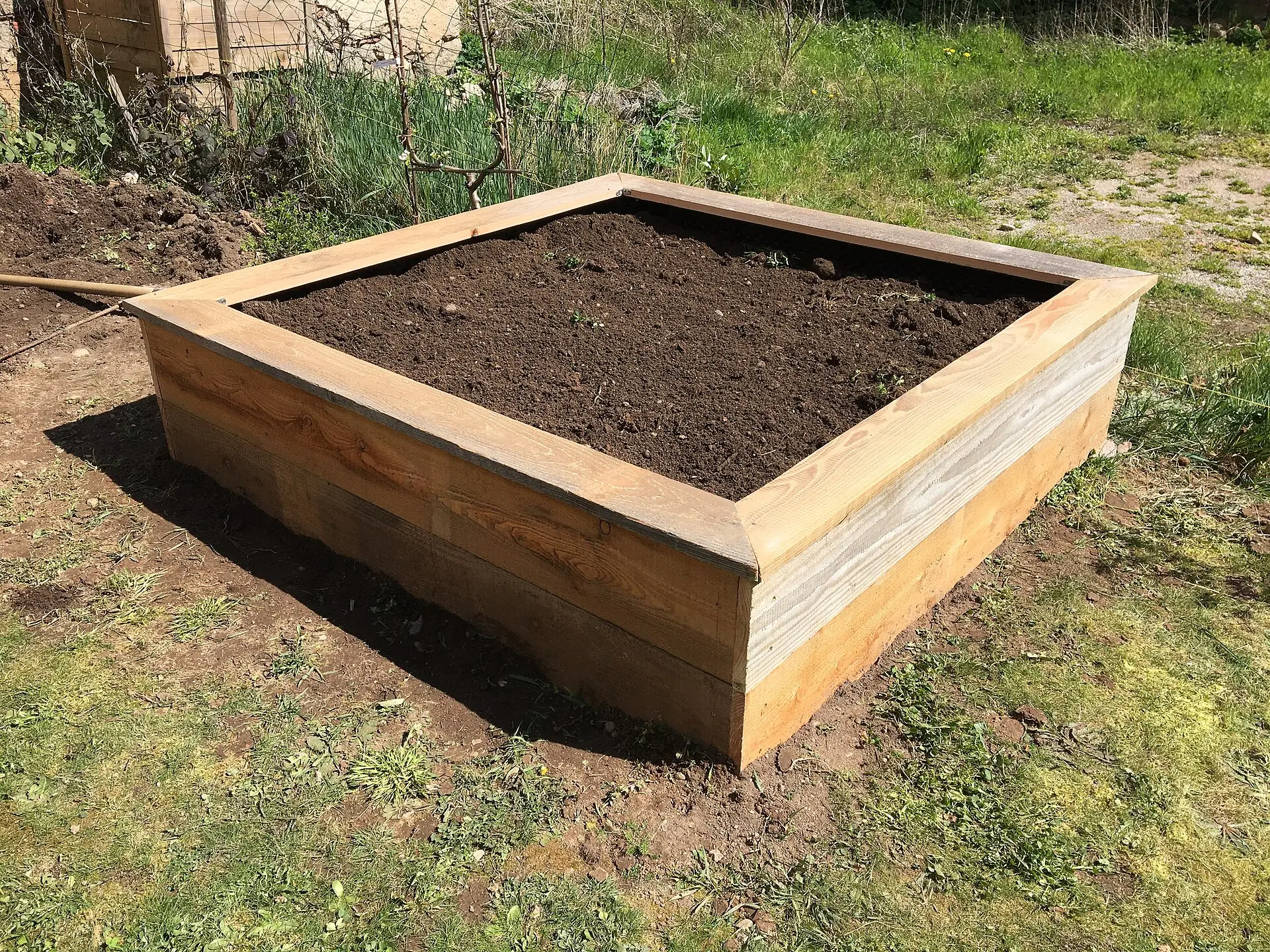
A 4x8 ft raised bed two boards high takes six 8-ft 2x10s, two 8-ft 4x4s for corner and mid-side posts, and about 60 exterior screws 3 in long. Cut two boards into four 45-in end pieces, screw everything into the posts rather than into end grain, check that both diagonals measure about 107-5/16 in, then level and fill with roughly 1.6 cubic yards of soil.

Key points
- UGA Extension notes that lumber comes in 8, 10 and 12 ft lengths and that a 4x8 bed is most easily built with 8-ft lumber, so the long sides need no cutting.
- Two courses of 2x10 (1-1/2 x 9-1/4 in actual) give an 18-1/2 in (470 mm) tall bed, well above the 10 in of soil UGA says most crops need.
- Screws driven into end grain hold on average only 75% as well as in side grain and behave erratically (USDA Wood Handbook), which is why the design screws every board into a post.
- Sealing cut ends is, per the Wood Handbook, probably the single most valuable step for wood exposed to water, because end grain absorbs water 10 to 100 times faster.
- The finished frame holds about 44 cu ft (1.63 cu yd, 1.25 m3) of soil once the six posts are subtracted.
The design in one paragraph: a 4x8 bed two boards high
A practical 4x8 ft raised bed is a box of 2x10 boards stacked two high, screwed into short 4x4 posts at the corners and at the middle of each long side. The long sides use full 8-ft boards, the ends are cut to fit between them, and the outside footprint is exactly 96 x 48 in (2438 x 1219 mm). This layout follows the logic of University of Georgia Extension circular C 1027-4: lumber is sold in 8, 10 and 12 ft lengths, and “a 4-ft x 8-ft bed is most easily built with 8-foot lumber”. The 4-ft width is the width UGA recommends for adults, who can reach the middle from either side without stepping on the soil.
Nominal lumber sizes are not actual sizes. The American Wood Council’s NDS Supplement (Tables 1A and 1B) gives the minimum dressed dry sizes used in the calculations below.
| Nominal size | Actual size, in | Actual size, mm | Role in this bed |
|---|---|---|---|
| 2x10 | 1-1/2 x 9-1/4 | 38 x 235 | Side boards, two courses |
| 4x4 | 3-1/2 x 3-1/2 | 89 x 89 | Corner and mid-side posts |
| 2x12 | 1-1/2 x 11-1/4 | 38 x 286 | Alternative: taller courses |
| 1x10 | 3/4 x 9-1/4 | 19 x 235 | Not recommended here: UGA says 1-in lumber needs a support about every 4 ft |
Two courses of 2x10 give a frame 18-1/2 in (470 mm) tall. UGA says most crops need at least 10 in of soil, so this height leaves margin for settling and for poor ground underneath.
Materials list and cut list for one 4x8 bed
The full shopping list for one bed two courses high is short, and only three of the boards need cutting. Quantities below are calculated from the dimensions above, with one saw kerf allowed per cut.
| Item | Quantity | Cut to | Use |
|---|---|---|---|
| 2x10 x 8 ft | 4 | Not cut (96 in) | Long sides, 2 courses |
| 2x10 x 8 ft | 2 | 2 pieces of 45 in each | End pieces, 2 courses |
| 4x4 x 8 ft | 2 | 6 pieces of 18-1/2 in | 4 corner posts, 2 mid-side posts |
| Exterior screws, 3 in (76 mm) | About 60 | - | 3 per board end at each post |
| End-grain sealer or field preservative | 1 small can | - | All cut ends |
Why 45 in for the ends: they sit between the long boards, so 48 in minus two board thicknesses of 1-1/2 in gives 45 in (1143 mm). Each end board yields two 45-in pieces with 6 in left over. Each 8-ft 4x4 yields five 18-1/2 in posts with offcut to spare, so two 4x4s cover the six posts with four left over for a third bed or a future upgrade.
The screw count is simple arithmetic. Each corner post receives four board ends (one long and one end board per course, two courses), with 3 screws per board end, so 12 screws per corner and 48 for four corners. Each mid-side post takes 3 screws per course, or 12 more. That gives 60. A 3-in screw passes through the 1-1/2 in board and leaves 1-1/2 in of thread in the post.
At the 35 lb per cubic foot density used in the AWC weight table, a 2x10 weighs about 3.4 lb per linear foot, so the six side boards together weigh roughly 160 lb (73 kg). Two people make the assembly easier. For other sizes or three courses, the raised bed lumber calculator produces the same kind of cut list automatically.
Choosing wood and screws before you cut anything
The choice of wood and fastener decides how long the frame lasts, because one face of every board stays against moist soil all season. The USDA Wood Handbook (chapter 14) explains that serious decay happens only when wood is above fibre saturation, about 30% moisture content on average, and that ground contact is a high decay hazard where treated wood or durable heartwood is the usual answer.
Screws should be rated for exterior use. The Wood Handbook’s fastenings chapter notes that galvanized coatings are applied for corrosion resistance and that 300 series stainless steel performs well in copper-based treated wood such as copper azole and ACQ. If you build with treated lumber or a tannin-rich species, read the guide to screws for raised beds before buying fasteners.
Step-by-step assembly in seven steps
The build order below keeps every screw in side grain, checks squareness before the bed is filled, and treats cut ends while they are still accessible.
- Prepare the site. Clear and roughly level a strip a little larger than 4 x 8 ft. UGA Extension says the soil in a raised bed should be flat, so the frame should be level when installed. Plan paths: UGA gives 12 in as a minimum, 18 to 24 in as ideal, and 4 ft where carts or wheelchairs must pass.
- Cut the parts. Cut two 2x10s into four 45-in end pieces and the two 4x4s into six 18-1/2 in posts. Cut square; a speed square or combination square helps.
- Seal every cut end. The Wood Handbook (chapter 16) says end grain is about 100 times more porous than side grain, that liquid water enters it 10 to 100 times faster, and that sealing end grain is “probably the single most valuable improvement” for wood exposed to water. For treated lumber, chapter 15 recommends field-treating cut surfaces, for example with a copper naphthenate product containing 1% to 2% copper.
- Build the two long sides flat on the ground. Lay two 8-ft boards edge to edge. Screw a post at each end, set back 1-1/2 in from the board ends so the end boards will fit in front of it, and a third post at the 48-in mark. Drive three screws per board into each post.
- Stand the sides up and add the ends. With a helper holding the long sides upright, place the 45-in end pieces between them, against the corner posts, and screw them to the posts. Avoid screwing the long board into the end of the short board: the Wood Handbook reports that withdrawal resistance from end grain averages only 75% of side grain and is erratic.
- Square the frame. Measure both diagonals. For a 96 x 48 in rectangle, each diagonal is the square root of (96 squared + 48 squared), about 107-5/16 in (2726 mm). Push the long corners until the two numbers match.
- Level, protect the bottom, fill. Shim or dig under the low corners until a level reads true along each side. Where gophers are present, UC IPM recommends laying hardware cloth or 3/4-in poultry wire under raised beds before planting; see the hardware cloth guide. Then fill.
How much soil the finished 4x8 bed holds
The soil volume of a 4x8 bed built this way is a little less than its outside dimensions suggest, because the boards and posts take up space. The calculation, step by step:
- Inside length: 96 in minus two end boards of 1-1/2 in = 93 in.
- Inside width: 48 in minus two long boards of 1-1/2 in = 45 in.
- Inside height: two 2x10 courses = 18-1/2 in.
- Gross volume: 93 x 45 x 18.5 = 77,422 cubic inches = 44.8 cu ft.
- Six 4x4 posts: 6 x 3.5 x 3.5 x 18.5 = 1,360 cubic inches = 0.8 cu ft.
- Net: about 44.0 cu ft, which is 1.63 cubic yards or 1.25 cubic metres.
A fresh fill settles, so it is simpler to top the bed up in later seasons than to heap soil above the boards on day one. The soil calculator converts the same volume into bags and handles other shapes.
Common variations on the basic 4x8 build
The same method adapts to taller beds, longer beds and different board sizes with only small changes.
| Variation | What changes | Note from the sources |
|---|---|---|
| Three courses of 2x10 | 9 boards, posts 27-3/4 in | Frame 27-3/4 in tall; soil volume rises by half |
| 2x12 instead of 2x10 | Same count, posts 22-1/2 in | 2x12 is 11-1/4 in actual (AWC) |
| 4x12 ft bed | 12-ft boards for long sides, 3 mid posts or more | UGA lists 12-ft lumber as standard |
| 1-in boards | Add posts about every 4 ft | UGA: 1-in lumber needs support about every 4 ft |
| Wheelchair access | 3 ft wide for adults, 24 in tall | UGA recommendation |
For a bed on sloping ground, the frame cannot simply sit on the surface; that case is handled in the guide to building on a slope, and stronger corner options are compared in the corner joints guide.
Method and limits
This guide combines the bed dimensions and depth guidance of UGA Extension circular C 1027-4, the actual lumber sizes and weight table of the AWC NDS Supplement (2018), and the fastening, finishing and preservative chapters of the USDA Wood Handbook (2021). The cut list, screw count, diagonal and soil volume are our own arithmetic from those dimensions. The sources do not give a tested lifespan for this particular design, a required screw spacing for garden beds, or a structural rating for soil pressure on 2x10 sides; the screw pattern here is a reasonable default, not an engineered value. Lumber dimensions can vary slightly from the published minimums, so measure your boards before cutting the end pieces.
Frequently asked questions
How much lumber do I need for a 4x8 raised bed?
For a bed two boards high you need six 8-ft 2x10 boards: four stay full length for the long sides and two are each cut into two 45-in end pieces. Add two 8-ft 4x4s, cut into six posts 18-1/2 in long, four for the corners and two for the middle of the long sides. A third course would add three more 2x10s and longer posts.
How deep should a 4x8 raised bed be?
UGA Extension says most garden crops need at least 10 inches of soil, and warns that 10 inches may not be enough for crops such as potatoes when the bed sits on a hard surface. Two courses of 2x10 lumber give 18-1/2 inches of frame height, which leaves room for settling and suits beds built on poor native soil.
Why is a raised bed usually 4 feet wide?
A 4-ft width lets an adult reach the centre of the bed from either side without stepping on the soil. UGA Extension recommends 4 ft for adults and 3 ft for children, and narrower beds of 3 ft (adults) or 2 ft (children) where wheelchair access is needed. Width also matches standard 8-ft lumber, since two 4-ft ends come from one board.
How many cubic yards of soil does a 4x8 raised bed take?
With 2x10 boards stacked two high, the inside measures about 93 by 45 by 18-1/2 inches. That is 44.8 cubic feet, or about 44 cubic feet after subtracting six 4x4 posts: roughly 1.63 cubic yards or 1.25 cubic metres. Order a little extra, because a newly filled bed settles over the first seasons.
Sources
- University of Georgia Cooperative Extension (2022). Raised Garden Bed Dimensions (Circular 1027-4)
- American Wood Council (2018). National Design Specification Supplement: Design Values for Wood Construction, 2018 edition, chapter 3 (Tables 1A and 1B)
- USDA Forest Service, Forest Products Laboratory (2021). Wood Handbook (FPL-GTR-282), chapter 8: Fastenings
- USDA Forest Service, Forest Products Laboratory (2021). Wood Handbook (FPL-GTR-282), chapter 16: Finishing of Wood
- USDA Forest Service, Forest Products Laboratory (2021). Wood Handbook (FPL-GTR-282), chapter 15: Wood Preservatives
- University of California Statewide IPM Program (2025). Pocket Gophers, Pest Notes Publication 7433