Hugelkultur in a raised bed: what filling with logs really does to nitrogen, settling and your crops
Hugelkultur means burying logs and branches under soil to fill a bed or mound. It saves soil but is not backed by peer-reviewed trials (Washington State University). Wood has a carbon-to-nitrogen ratio of 100-500:1, so keep it well below the root zone, cover it with finished compost and soil, and expect the bed to sink as the wood rots.
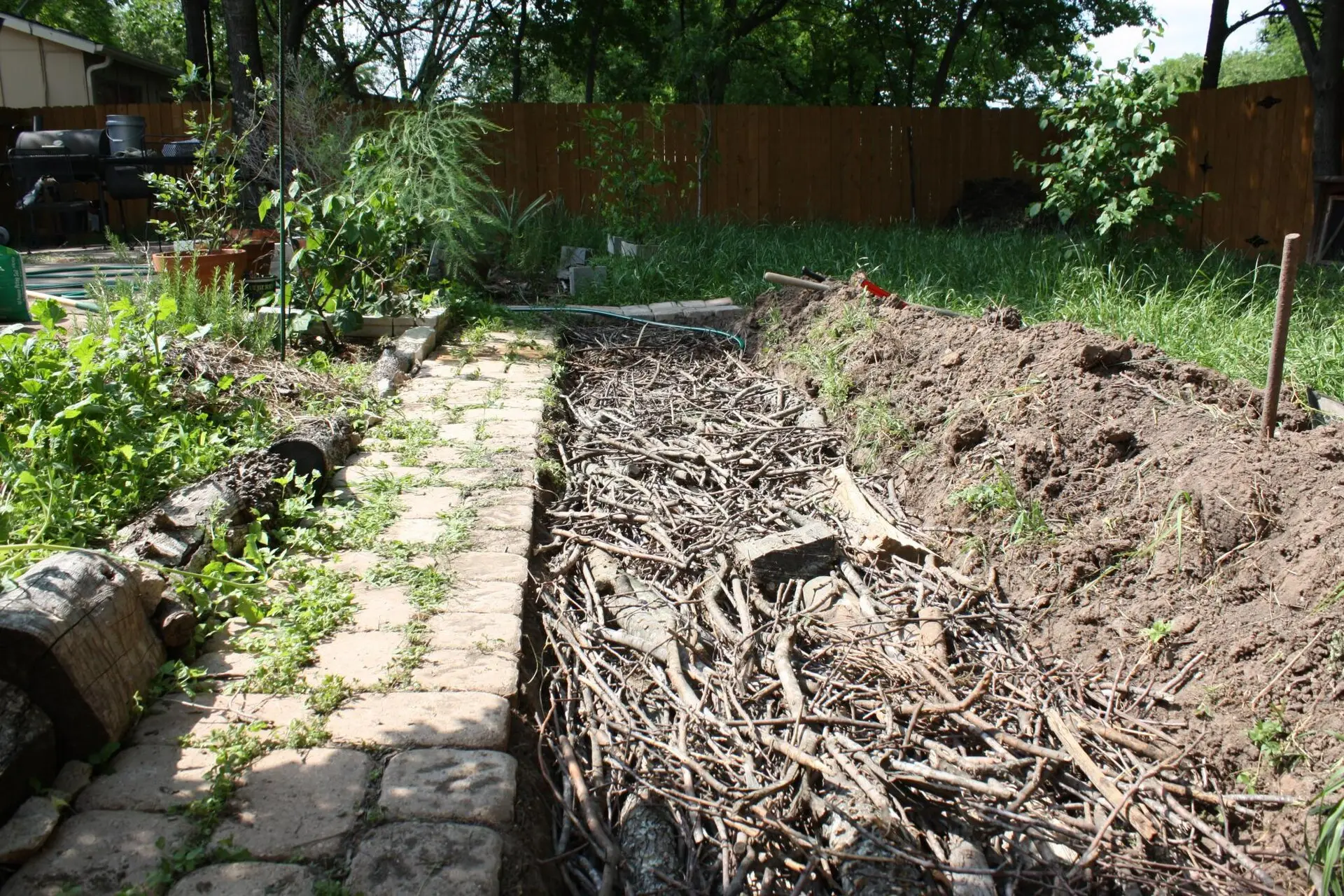

Key points
- Washington State University Extension found no peer-reviewed studies on hugelkultur; a 2024 Kansas State report found no controlled, replicated research.
- Wood chips and sawdust have C:N ratios of 100-500:1 versus about 30:1 for a balanced compost (Cornell), so fresh wood near roots can tie up nitrogen.
- The original German method expects mounds to settle from about 3 ft and to be rebuilt from scratch after 5 to 6 years.
- Univ. of Arizona Master Gardeners recommend birch, maple, oak or spruce, and list black walnut, cedar, redwood, black locust and pine among woods to avoid.
- A buried wood layer is not a barrier against contaminated ground; only a raised bed with a soil barrier is (WSU).
What hugelkultur is and where the term comes from
Hugelkultur (German Hügelkultur, “mound culture”) is a way of building a growing bed on top of buried logs, branches and other woody debris, covered with leaves, manure, compost and soil. Washington State University Extension (WSU) traced the term to a 1962 German brochure by the gardener Hermann Andrä, later revised and reprinted with Hans Beba through the 1970s and 1980s. Popular claims that it is “centuries old” are not supported by that history.
The original instructions, as translated by WSU, are specific:
- Remove the sod from a rectangular area.
- Lay branches and deadfall along the centre line, about 2 ft (60 cm) high, tapering to the ground at the sides.
- Add more woody debris, the turned sod, soil, a foot of dead leaves, a few inches of composted manure and 3 to 4 in of compost.
- Leave the mound to rest for several months while it decomposes and settles from about 3 ft (90 cm) to a workable height.
- Expect a lifespan of five to six years, after which the mound is “rebuilt from scratch”.
In the raised-bed world, the word is now used more loosely for any bed whose lower part is filled with logs and branches to save on soil. That use is the subject of this page.
What the evidence actually says
The scientific record on hugelkultur is close to empty. WSU states that “there are no peer-reviewed, scientific studies on Hügelkultur”: a few university students have run projects, but none were published in journals. A 2024 report from Kansas State University by Sara Hazan, who ran some of those student trials, likewise found no controlled, replicated research, and flagged settling that may damage roots and runoff and erosion from steep mound sides. The University of Arizona’s Yavapai County Master Gardeners conclude that hugelkultur “is not recommended as being science-based”.
| Popular claim | What the sources say |
|---|---|
| Holds water, needs little or no irrigation | Not measured in published trials; Arizona notes some irrigation may be needed in dry climates |
| Releases nutrients as wood rots | Rich organic layers can release excess nutrients into soil and water (WSU); fresh wood ties up nitrogen (Cornell, Texas A&M) |
| Permanent, self-sustaining bed | Mounds collapse as wood breaks down and must be rebuilt (WSU, Arizona) |
| Lets you garden over poor or “poisoned” soil | No barrier between buried wood and the ground below; only raised beds with soil barriers are reliable (WSU) |
| Cheap way to fill a deep bed | True in volume terms; the cost moves to later top-ups as the bed sinks |
None of this means plants fail in hugelkultur beds. It means the claimed advantages over an ordinary raised bed with good soil have not been demonstrated, and the drawbacks below are predictable from basic soil science.
Nitrogen drawdown: why fresh wood and roots should not mix
Decomposing wood can starve nearby plants of nitrogen, because the microbes that break it down need more nitrogen than the wood contains. Cornell’s composting reference puts the ideal carbon-to-nitrogen (C:N) ratio for decomposition at about 30:1, and lists these typical values:
| Material | Typical C:N ratio |
|---|---|
| Wood chips or sawdust | 100-500:1 |
| Newspaper or cardboard | 560:1 |
| Bark | 100-130:1 |
| Straw | 40-100:1 |
| Leaves | 30-80:1 |
| Grass clippings | 15-25:1 |
| Vegetable scraps | 15-20:1 |
| Manures | 5-25:1 |
| Finished compost | about 10-15:1 |
At 100-500:1, wood is three to more than sixteen times richer in carbon, relative to nitrogen, than the 30:1 balance (100 / 30 = 3.3; 500 / 30 = 16.7). Microbes make up the shortfall from the soil around them. Texas A&M AgriLife states the practical result: uncomposted organic material deprives plants of nitrogen. Cornell adds that sawdust’s carbon is more available than that of chips because of its larger surface area, so fine wood waste acts faster than logs.
Two design rules follow:
- Keep wood out of the root zone. Large logs at the bottom of a deep bed expose far less surface to the soil than chips mixed through it.
- Put nitrogen-rich, finished material above the wood. The original method itself places manure and compost over the woody core; a layer of finished compost (C:N around 10-15:1) between wood and topsoil is the safest buffer.
Settling: plan for a bed that sinks
A hugelkultur bed loses height every year as the wood decomposes, and the loss is far larger than in a soil-filled bed. The original method expects a 3 ft mound to settle over several months before planting, and to be rebuilt after five to six years. Arizona’s handout says to “expect the Hügelkultur mound to shrink over time”.
In a framed bed this has three consequences:
- The soil surface drops below the boards, so you will top up more often than with a mineral soil mix; our page on raised bed soil settling covers how to measure and refill.
- Voids open as logs collapse; Hazan’s report notes that settling may harm roots.
- Perennials are a poor fit. WSU notes that this structural instability argues against planting fruit trees and bushes in mounds, even though the original authors recommended it.
Which woods to use and which to avoid
The University of Arizona handout (Yavapai County Master Gardeners, February 2026) recommends starting with larger logs of birch, maple, oak or spruce, and lists ten species to avoid. It does not give a reason for each.
| Recommended | Avoid (per the handout) | Never use |
|---|---|---|
| Birch, maple, oak, spruce | Black walnut, cedar, redwood, black locust, pine, willow, sequoia, acacia, cypress, black cherry | Railroad ties, treated lumber |
Two patterns help explain the list. Several of the avoided species (cedar, redwood, black locust, cypress) are the ones prized for decay resistance in bed frames, which is the opposite of what you want in a layer meant to rot; see our wood durability ratings. Black walnut is listed because of juglone, a compound it produces. Iowa State University Extension notes that very little research shows a consistent effect of juglone in garden soils, but that tomato-family crops (tomato, potato, eggplant, pepper) have been observed to grow poorly near walnuts. Excerpts collected by the University of Washington’s Miller Library, attributed to Ohio State University, say juglone in composted leaves degrades in two to four weeks and in soil within about two months, and that fresh walnut sawdust or chips are not suggested near sensitive plants. With large logs decaying over years, the cautious choice is to leave walnut out.
A cautious method for a deep wooden raised bed
If you have a tall frame and a supply of untreated hardwood logs, the following sequence applies the sources above. It is a synthesis, not a tested protocol.
- Use only deep beds. The RHS already suggests rubble or subsoil in the bottom of beds deeper than 50 cm (20 in); logs fill the same space. A frame of three 2x10 boards (38 x 235 mm actual) gives 27.75 in (705 mm) of depth.
- Reserve the root zone for soil. Check the rooting depth of your crops in how deep a raised bed should be and keep at least that depth free of wood. For shallow-rooted crops, 12 to 18 in (30 to 45 cm) of soil above the wood is a reasonable floor.
- Lay logs, then fill the gaps. Arizona suggests filling the gaps between logs and sticks with grass clippings and leaves, noting “the more compact the better”.
- Add a compost buffer. Cover the wood with finished compost before the soil layer.
- Fill with a proper soil mix, following raised bed soil mix ratios.
- Leave room to top up. Fill to the rim knowing the level will fall.
Worked example for a 4x8 ft frame 27.75 in deep:
- Total volume: 4 x 8 x (27.75 / 12) = 74 cu ft (2.1 m3).
- Wood layer 12 in deep: 4 x 8 x 1 = 32 cu ft (0.91 m3) of bed volume, less the gap filling.
- Soil and compost above: 74 - 32 = 42 cu ft (1.19 m3), which gives 15.75 in (40 cm) of root zone.
The saving is real at fill time, but it is partly paid back in later top-ups as the wood layer shrinks.
Do not use hugelkultur to cover contaminated ground
The original authors recommended mounds for gardening on top of “poisoned layers” of soil, and WSU rejects this directly: there is no barrier between the underlying soil and a mound built on it. WSU’s conclusion is that traditional raised beds with soil barriers are the only reliable way to avoid contaminated ground. If that is your situation, see raised beds on contaminated soil.
Method and limits
This page relies on extension publications from Washington State, Kansas State, Arizona, Texas A&M and Iowa State, Cornell’s composting reference and the RHS. Because no peer-reviewed trials exist, the benefits of hugelkultur cannot be quantified, and neither can the size of its drawbacks: we found no measured figure for how much nitrogen a buried log layer immobilizes, or how many inches a framed hugelkultur bed loses per year. The Oklahoma State University fact sheet on hugelkultur could not be accessed. The Arizona list of woods to avoid gives no reasons; the explanations above are based on other sources and are marked as such.
Frequently asked questions
Does hugelkultur actually work?
Nobody has shown it under controlled conditions. Washington State University Extension states there are no peer-reviewed, scientific studies on hugelkultur, only student projects, and a 2024 Kansas State University report found no controlled, replicated research. Plants do grow in hugelkultur beds, but claims about water savings, warmth and fertility have not been measured against ordinary raised beds.
Can I put logs in the bottom of a raised bed?
Yes, in deep beds, with precautions. Keep the wood below the depth your crops root into, use sound, untreated wood from species that rot readily, cover it with finished compost and at least the soil depth your crops need, and plan to top up as the wood decays and the surface sinks.
Will rotting wood steal nitrogen from my vegetables?
It can. Wood chips and sawdust have carbon-to-nitrogen ratios of 100 to 500:1 according to Cornell, far above the 30:1 that microbes need, so decomposers draw extra nitrogen from the surrounding soil. Texas A&M AgriLife notes that uncomposted organic material deprives plants of nitrogen. Burying large logs deep reduces the contact area near roots.
What wood should not be used in hugelkultur?
Yavapai County Master Gardeners (University of Arizona) list black walnut, cedar, redwood, black locust, pine, willow, sequoia, acacia, cypress and black cherry as woods to avoid, and rule out railroad ties and treated lumber. Black walnut contains juglone, which tomato-family crops are observed to be sensitive to. The handout recommends birch, maple, oak and spruce.
How long does a hugelkultur bed last?
The original German instructions, as translated by Washington State University, say mounds have a lifespan of five to six years and then need to be rebuilt from scratch. Meanwhile the surface sinks as wood decomposes; the University of Arizona handout says to expect the mound to shrink and to rebuild it as the woody material breaks down.
Sources
- Washington State University Extension (L. Chalker-Scott) (2022). Hügelkultur: what is it, and should it be used in home gardens? (FS283E)
- Kansas State University, K-State Research Exchange (S. Hazan) (2024). The anatomy of hügelkultur and dissecting the key claims
- Yavapai County Master Gardeners, University of Arizona Cooperative Extension (2026). Hügelkultur (handout)
- Cornell Waste Management Institute, Cornell University (1996). Compost Chemistry: C/N Ratio
- Texas A&M AgriLife Extension (P. Files, M. Arnold, D. Welsh, F. Dainello) (2009). Raised Bed Gardening (E-560)
- Iowa State University Extension and Outreach, Yard and Garden (2023). What plants are sensitive to the juglone produced by black walnuts?
- Royal Horticultural Society (2025). How to make a raised bed