Is pressure-treated wood safe for a vegetable garden? What CCA, copper azole and ACQ studies measured
Modern copper-based treated lumber (copper azole, micronized copper azole, ACQ) is considered acceptable for vegetable raised beds by Oregon State University Extension: in a four-season trial, soil copper rose only within 1 inch of the boards and vegetables showed no increase. CCA, which contains arsenic, was withdrawn from US residential uses at the end of 2003 and should not be used for new beds.
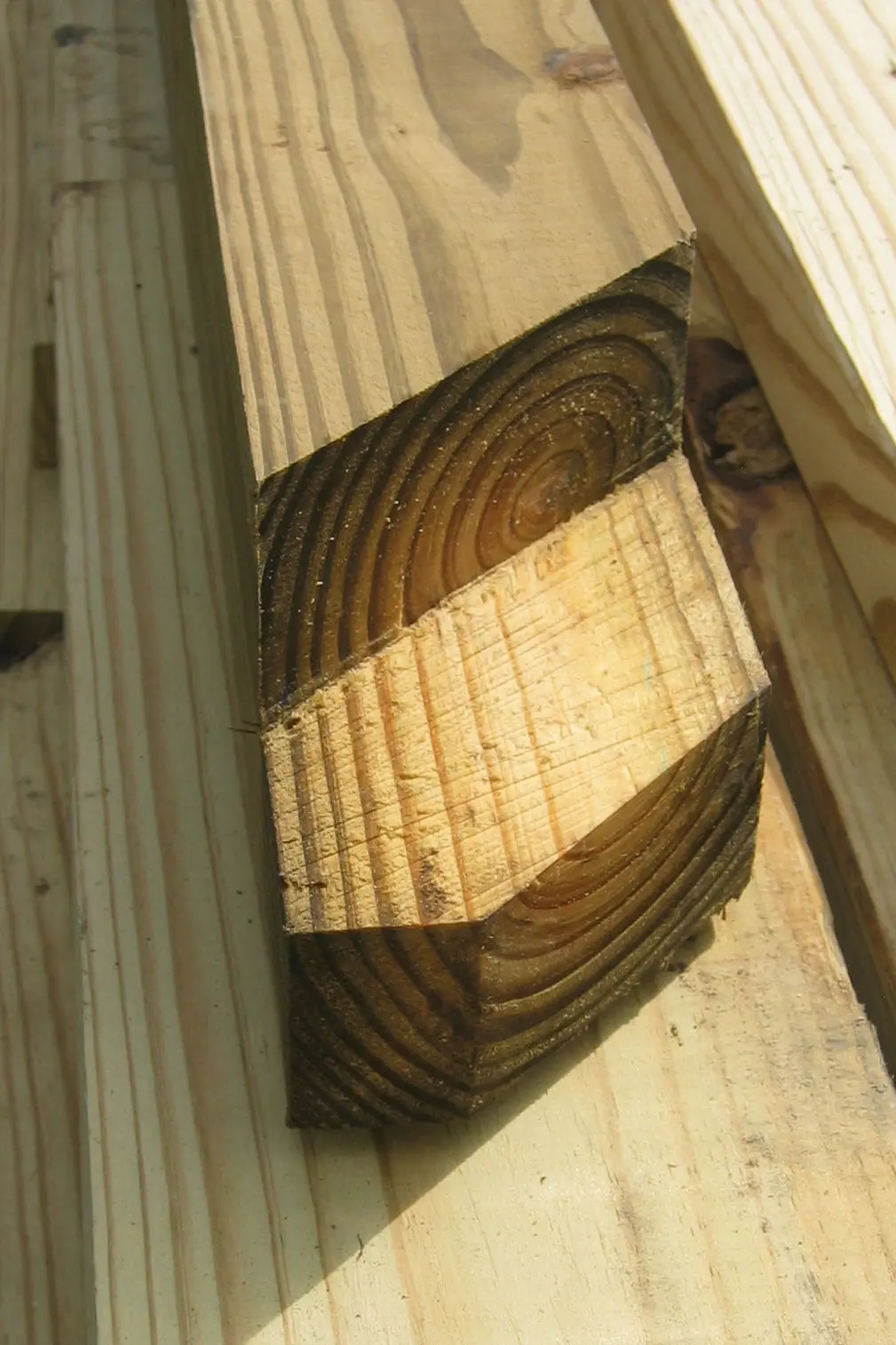

Key points
- Manufacturers stopped producing CCA-treated wood for most residential uses in December 2003 (US EPA); current retail treated lumber is copper based.
- In an OSU trial with copper azole beds, soil copper rose only within 0-25 mm of the wood and no vegetable showed a copper increase over 4 seasons.
- In a Connecticut study of uncoated CCA boxes, soil within 2 cm of the wood exceeded 10 mg/kg arsenic within a year; 6 cm away it was close to background.
- For a bed, buy lumber labelled for ground contact (AWPA UC4A) and brush preservative on cut ends.
- Certified organic growers in the US may not use arsenate-treated lumber in contact with soil (7 CFR 205.206(f)).
The short answer: CCA is gone from retail, copper is what you buy now
The treated lumber sold today at US retail is not the arsenic-based wood that gave “pressure-treated” its reputation. Chromated copper arsenate (CCA) dominated the treated-wood market from the late 1970s until 2004, according to the USDA Wood Handbook. The US EPA reports that manufacturers voluntarily stopped producing CCA-treated wood for most residential uses in December 2003, and the handbook notes that label changes now limit CCA mainly to industrial uses, so it is generally not available at retail.
Today’s residential products use copper as the main biocide, chosen for its fungicidal properties and low toxicity to mammals, usually combined with an organic co-biocide such as an azole or a quaternary ammonium compound. The question for a vegetable bed is therefore not “is arsenic leaching into my carrots” but “how much copper moves into the soil, and does it reach the plants”. Two recent studies and one older one give measured answers.
The preservatives you will see on the tag
Each treated piece should carry a brand, ink stamp or end tag showing the inspection agency, the preservative, the retention and the use category, according to the Wood Handbook. These are the names you are likely to meet:
| Tag name | What it is (Wood Handbook ch. 15) | Residential status |
|---|---|---|
| CCA (type C) | Chromium, copper and arsenic oxides: 47.5% CrO3, 34.0% As2O5, 18.5% CuO | Withdrawn from most residential uses end of 2003 (US); arsenic treatments banned in EU homes |
| ACQ (types C, D) | Alkaline copper quat: 50-67% copper oxide plus 33-50% quaternary ammonium | Sold for residential use |
| CA-B, CA-C | Copper azole: amine copper with tebuconazole and/or propiconazole | Commonly used for decking and dimension lumber at lumber yards |
| MCA, MCA-C | Micronized copper azole: copper ground into fine particles, plus azole | Common on southern pine in the eastern US (OSU) |
| Copper HDO (CX-A) | Copper with HDO co-biocide | Above-ground uses only |
| Borates (SBX) | Boron salts | Leachable; protected, above-ground uses only |
Borates are not an option for a bed, because they wash out of wood exposed to rain and wet soil.
Use category and retention: why “ground contact” matters for a bed
Treated lumber is sold for different exposures, and the American Wood Protection Association (AWPA) use categories printed on the tag tell you which. The Wood Handbook (Table 15-6) defines UC3B as general above-ground use, fully exposed (decking, fence pickets), and UC4A as general ground contact or fresh water, or above-ground uses that are structurally critical or have a high decay hazard (fence and deck posts). UC4B covers ground contact for critical or hard-to-replace parts.
A raised bed side is in contact with soil, so Oregon State University advises buying lumber rated for ground contact. The difference is in the retention, the amount of preservative left in the wood. Values from Wood Handbook Table 15-1 for southern pine (lb/ft3 is our conversion, kg/m3 divided by 16):
| Preservative | UC3B, above ground, exposed | UC4A, ground contact | UC4B, critical ground contact |
|---|---|---|---|
| CA-C | 1.0 kg/m3 (0.06 lb/ft3) | 2.4 kg/m3 (0.15 lb/ft3) | 5.0 kg/m3 (0.31 lb/ft3) |
| CA-B | 1.7 kg/m3 (0.11 lb/ft3) | 3.3 kg/m3 (0.21 lb/ft3) | 5.0 kg/m3 (0.31 lb/ft3) |
| MCA | 1.0 kg/m3 (0.06 lb/ft3) | 2.4 kg/m3 (0.15 lb/ft3) | 5.0 kg/m3 (0.31 lb/ft3) |
| ACQ-D | 2.4 kg/m3 (0.15 lb/ft3) | 6.4 kg/m3 (0.40 lb/ft3) | 9.6 kg/m3 (0.60 lb/ft3) |
| CCA (for reference) | 4.0 kg/m3 (0.25 lb/ft3) | 6.4 kg/m3 (0.40 lb/ft3) | 9.6 kg/m3 (0.60 lb/ft3) |
Ground-contact lumber carries more than twice the copper azole of above-ground lumber. A board stamped UC3B used as a bed wall is under-treated for the job. Treatment also mainly protects the outer, treated shell, which is why OSU recommends brushing a preservative onto every cut end. The Wood Handbook notes that copper naphthenate can be brushed on at 1 to 2 percent copper for field treatment.
What the Oregon State trial measured with copper azole beds
The most direct evidence on modern treated beds is a multi-year trial by Oregon State University, reported as Extension publication EM 9879 (revised April 2026) and in Wood and Fiber Science (Presley and Konkler, 2026). Four beds of about 4 by 10 feet (1.2 x 3.0 m) were built in 2021 from 2x12 Douglas-fir at Albany, Oregon: two untreated, and two treated with copper azole (CA-C) at 2.4 kg/m3, the AWPA ground-contact retention.
Results after four growing seasons:
- Soil next to the boards. Copper in the 0 to 25 mm (0 to 1 inch) band against treated wood measured 77.8 to 101 ppm, against 21.1 to 33.2 ppm next to untreated wood. OSU describes the increase as 20 to 68 ppm above the untreated beds.
- Soil farther away. No difference at 3 to 4 inches (75 to 100 mm) from the wall or in the center of the bed.
- In context. The paper cites 140 ppm as the level considered elevated in Willamette Valley soils, and notes that US soils can naturally contain up to about 500 ppm.
- Vegetables. Copper in the vegetables did not differ between treated and untreated beds over four seasons. The one statistical difference was radish in year four, where the untreated beds were higher (7.5 ppm) than the treated ones (3.7 ppm).
- Durability. After six years the untreated beds showed brown rot through more than half of the cross section on the inside lower half, while the treated beds were mostly intact.
The trial is one site, one wood species, one preservative and a mild, wet climate. It is still the closest match to a home raised bed in the published literature we found.
What the Connecticut study found with old CCA beds
The best data on arsenic from CCA in garden beds comes from the Connecticut Agricultural Experiment Station (Stilwell, Musante and Sawhney, 2006). They built boxes from CCA lumber, filled them with 90% sandy loam and 10% compost, and followed them for two years, with and without coatings on the wood.
| Measurement | Uncoated CCA | Context |
|---|---|---|
| Soil arsenic within 2 cm (0.8 in) of the wood | Rose from 3.7 to 29 mg/kg | Exceeded the Connecticut limit of 10 mg/kg within one year |
| Soil arsenic 6 cm (2.4 in) from the wood | Within 0.7 mg/kg of the control | Background was 3 to 4 mg/kg |
| Arugula leaves within 2 cm of the wood | 60 mg/kg dry weight | Control below 1 mg/kg |
| Chives within 2 cm of the wood | 75 mg/kg dry weight | |
| Lettuce, basil within 2 cm | 4.9 and 6 mg/kg dry weight | |
| Arugula in the center of the box (13 cm away) | 7 to 18 mg/kg dry weight |
Coatings changed the result. An opaque acrylic finish cut soil arsenic next to the wood by about 80% and polyurethane by about 95%, keeping soil below 10 mg/kg (6.8 and 4.6 mg/kg, against 3.0 for the control). Penetrating finishes helped at first, but after two years they made no significant difference. Film coatings reduced arsenic in plants by 50 to 84%. More on coatings in finishes for raised bed wood.
The OSU publication states that it found no evidence that CCA raises arsenic in vegetables. The Connecticut data show it can, for leafy crops grown right against uncoated boards. Both statements come from credible sources; the difference is distance from the wood and crop type.
What to do with an existing CCA bed or old lumber
The US EPA does not require existing CCA structures, or the soil around them, to be removed. Its guidance for people who keep them: do not reuse CCA wood as mulch, wear goggles and a dust mask when sawing it, wash your hands after handling it, and consider applying a penetrating coating (oil- or water-based stain) regularly, which may reduce leaching. The Connecticut data suggest a film-forming coating is more effective than a penetrating one.
Practical options, from most to least cautious:
- Replace the bed with untreated durable wood or ground-contact copper-treated lumber, and replace the soil within about 6 cm (2.4 in) of the old walls, the zone where the Connecticut study measured the arsenic rise.
- Keep the bed, coat the inside faces with a film finish, and grow leafy greens and herbs away from the walls.
- Keep the bed as is for ornamentals.
For disposal, the Wood Handbook says treated wood is not a hazardous waste under US federal law, but it “must not be burned in open fires or in stoves, fireplaces, or residential boilers”. Local rules may be stricter. If your concern is the native soil rather than the boards, see raised beds on contaminated soil.
Organic certification, liners and other precautions
The US National Organic Program is stricter than general safety guidance. Under 7 CFR 205.206(f), a certified producer must not use lumber treated with arsenate or other prohibited materials for new installations or replacements in contact with soil or livestock. Kentucky State University advises avoiding ACQ and copper azole lumber as well if you want to meet NOP rules; check with your certifier.
Kentucky State also suggests lining treated beds with heavy plastic and planting root crops at least 12 inches (30 cm) from treated lumber. With copper azole, the OSU data do not show a need for this, but it is a low-cost precaution. A liner has trade-offs for drainage and for the wood itself; see whether to line a raised bed.
If you prefer to avoid preservatives altogether, OSU’s own suggestion is cedar, redwood, concrete block or stone. Durable species are compared in the best wood for raised beds.
Method and limits
We used the USDA Wood Handbook (2021) for preservative chemistry, use categories and retentions; the US EPA for the CCA timeline and homeowner guidance; and two field studies of garden beds: Oregon State University (copper azole, 2021-2026) and the Connecticut Agricultural Experiment Station (CCA, 2006). We found no comparable open field study of ACQ or MCA beds, so the OSU result should not be assumed to transfer exactly to them. Retentions are for southern pine as tabulated by the handbook; other species and current AWPA standards may differ. Limits for arsenic and copper in soil vary by jurisdiction.
Frequently asked questions
Is pressure-treated wood safe for vegetable gardens?
For current copper-based products, the field data are reassuring. Oregon State University built raised beds from copper azole treated Douglas-fir and measured soil and vegetables for four seasons: copper rose only in the first inch of soil next to the boards, stayed within the natural range, and no vegetable showed an increase. OSU recommends ground-contact rated lumber and sealing cut ends.
How can I tell if old wood is CCA-treated?
Treated pieces are supposed to carry an ink stamp or end tag naming the preservative, retention and use category, so look for 'CCA' on the tag. Lumber sold for home use after 2003 in the US is generally not CCA. Wood of unknown age with a greenish cast and no tag cannot be identified by eye, so treat it as possibly CCA.
Should I remove an old CCA raised bed?
The US EPA does not require removal of existing CCA structures or of the soil around them. A Connecticut study found arsenic rose mainly within 2 cm of uncoated CCA boards, and that a film finish such as polyurethane or opaque acrylic cut soil arsenic by about 80 to 95 percent. Replacing the bed with untreated or copper-treated wood is the more cautious option.
Should I line a raised bed made of treated wood?
Kentucky State University suggests lining treated lumber with heavy plastic and planting root crops at least 12 inches from it. With copper azole lumber, Oregon State found no copper increase in vegetables, so a liner is a precaution rather than a measured necessity. A liner can also hold moisture against the wood if water cannot drain.
Sources
- US Environmental Protection Agency (2025). Chromated Arsenicals (CCA)
- USDA Forest Service, Forest Products Laboratory (2021). Wood Handbook (FPL-GTR-282), chapter 15: Wood Preservatives
- Oregon State University Extension Service (2026). Using Pressure-Treated Wood for Raised Bed Construction in Oregon (EM 9879)
- Wood and Fiber Science 58(2): 91-98 (2026). Copper migration from treated wood garden boxes into soil and vegetable biomass, Part II (Presley and Konkler)
- Connecticut Agricultural Experiment Station, Frontiers of Plant Science 56(2) (2006). Effects of Coating CCA Pressure Treated Wood on Arsenic Levels in Plants and Soil (Stilwell, Musante, Sawhney)
- US Code of Federal Regulations (Legal Information Institute, Cornell) (2026). 7 CFR 205.206 Crop pest, weed, and disease management practice standard (current e-CFR text)
- Kentucky State University, College of Agriculture (2019). What Wood is Safe to Use in My Garden?