Raised bed soil mix: what ratio of topsoil to compost the extension services actually recommend
For a vegetable raised bed on open ground, mix mineral topsoil with roughly 25 to 35% compost by volume: Penn State suggests 70% soil to 30% compost, Oregon State up to 25% compost, Maryland 1 part compost to 2 parts topsoil. Do not fill with compost alone. On concrete, Maryland suggests compost plus soilless mix, 1:1.
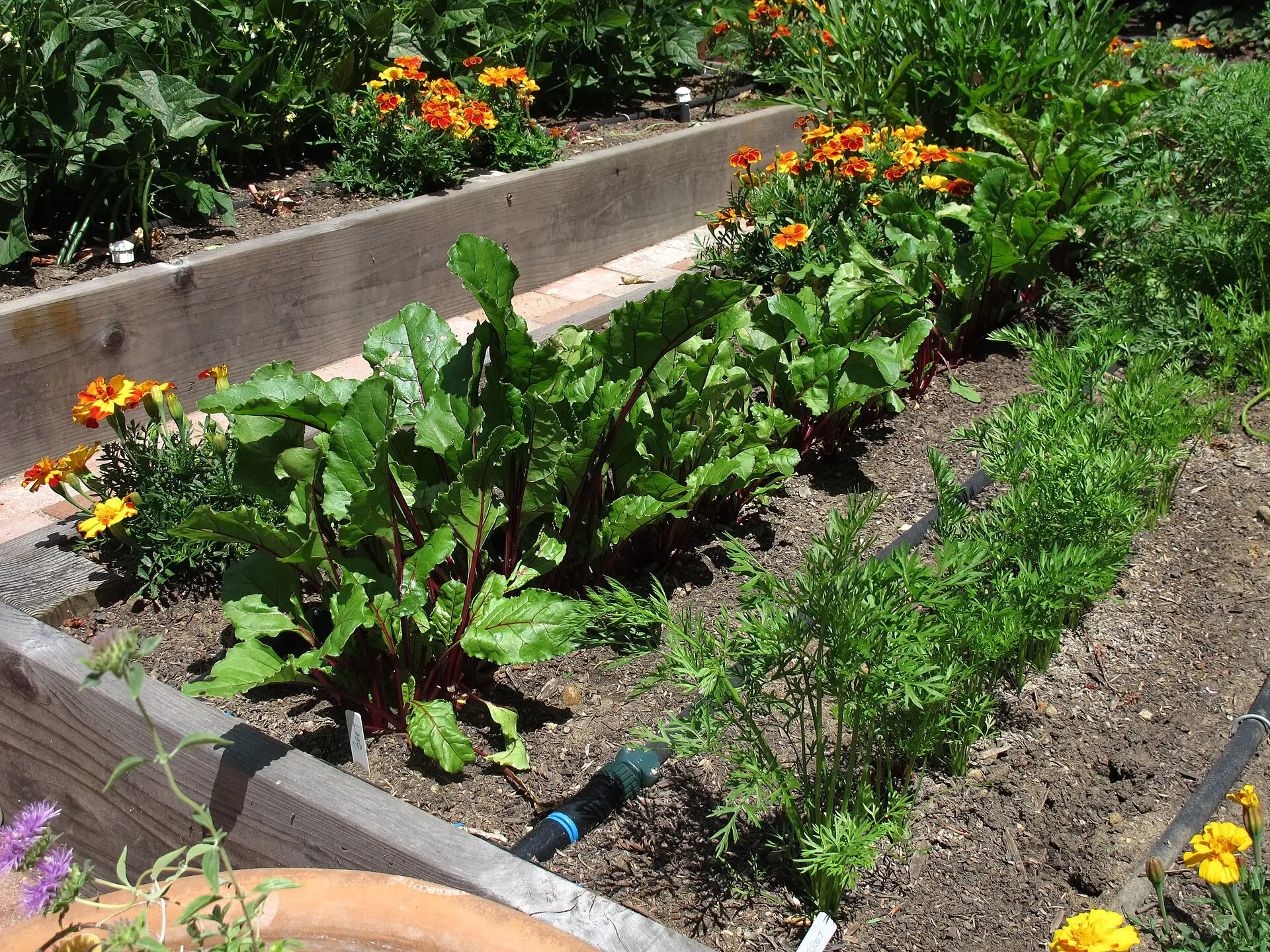

Key points
- Extension recommendations cluster between about 25 and 50% compost by volume; Clemson goes as low as 10 to 20%.
- Oregon State warns against filling beds with compost alone: compost lacks the mineral fraction that holds structure and nutrients.
- The more organic matter in the mix, the sooner the level drops and needs topping up (Texas A&M AgriLife).
- Mel's Mix (1/3 peat, 1/3 vermiculite, 1/3 compost) contains no topsoil, relies on peat, and settles faster than soil-based blends.
- Test before planting: Maryland targets pH 6.2 to 6.8 and advises against vegetables above 400 ppm total lead.
What extension services recommend for raised bed soil
Most university extension services recommend filling a raised vegetable bed with mineral topsoil blended with compost, not with compost or potting mix alone. The ratios differ, but they fall in a narrow band. The table below lists each recommendation as published, converted to a percentage of compost by volume where possible.
| Source | Recommended blend (by volume) | Compost share | Context |
|---|---|---|---|
| Penn State Extension | 70% soil, 30% compost | 30% | General raised beds |
| Univ. of Maryland Extension | Compost:topsoil 1:2 or 1:1 | 33 to 50% | Beds on compacted ground |
| Univ. of Maryland Extension | Compost + soilless mix 1:1, up to 20% topsoil if 16 in (40 cm) deep or more | 50% | Beds on hard surfaces |
| Oregon State EM 9308 | Excavated soil with up to 25% compost; landscape mixes about 1/3 compost | 25 to 33% | Refilling with native soil |
| Clemson HGIC 1257 | Compost at 10 to 20% of total volume | 10 to 20% | Amending bed soil |
| Utah State | Native topsoil plus 30 to 50% composted organic matter, or 1:1:1 compost, drainage material, native soil | 30 to 50% | Utah soils |
| Texas A&M E-560 | 3/4 topsoil + 1/4 compost, 2/3 + 1/3, or 1/2 + 1/2 | 25 to 50% | Common commercial blends |
| RHS (UK) | 7 topsoil : 3 organic matter : 2 sharp sand | 25% | Standard mix |
| RHS (UK) | 7 topsoil : 3 organic matter : 4 sharp sand | 21% | Beds on hard surfaces |
| Square Foot Gardening Foundation | 1/3 peat, 1/3 vermiculite, 1/3 blended compost | 33% (no topsoil) | Mel’s Mix |
The RHS percentages are simple arithmetic: 7 + 3 + 2 = 12 parts, so organic matter is 3/12 = 25%, topsoil 58% and sand 17%. On hard surfaces, 7 + 3 + 4 = 14 parts, giving 21% organic matter and 29% sand.
The consensus is clear: somewhere between a quarter and a third compost suits most vegetable beds on open ground, with half compost at the upper end. Maryland frames the target as a lab measurement rather than a recipe: organic matter of 25 to 50% by volume, or 5 to 15% by weight.
Why a raised bed needs mineral soil, not just compost
Oregon State University Extension states it directly: “Don’t fill raised beds with compost alone.” Compost lacks the mineral component, the sand, silt and clay particles that give soil its structure and hold nutrients. Three practical problems follow from an all-organic fill:
- Shrinkage. Texas A&M notes that “the higher the organic material content the sooner you will need to add more soil/compost”. Organic matter decomposes; mineral particles do not. Our page on why raised bed soil settles works through the numbers.
- Nutrient excess. Oregon State warns that excess compost can release phosphorus and potassium beyond what plants use, which then leaches.
- Salts. The same publication notes that mushroom and manure composts can be high in soluble salts.
Texas A&M adds one more caution: uncomposted organic material deprives plants of nitrogen while it breaks down, so the compost must be finished. This is the main risk of filling a deep bed with fresh wood, covered in our hugelkultur page.
Texture matters too. Texas A&M says sandy clay loam is generally best for raised beds, and that clay soils should be amended with at least 1/3 coarse sand, organic matter or perlite. Utah State recommends that beds shallower than 12 in (30 cm) be left bottomless so roots can reach the native soil below, which should be loosened 6 to 12 in (15 to 30 cm) deep.
How to calculate the volume and split it
To buy the right quantity, compute the bed volume first and then split it by your chosen ratio. For a 4x8 ft bed filled 12 inches deep, with a 70/30 mix:
- Volume = 4 ft x 8 ft x 1 ft = 32 cu ft.
- In cubic yards: 32 / 27 = 1.19 cu yd. In metric: 32 x 0.02832 = 0.91 m3.
- Topsoil at 70%: 32 x 0.70 = 22.4 cu ft (0.63 m3).
- Compost at 30%: 32 x 0.30 = 9.6 cu ft (0.27 m3), or ten 1 cu ft bags.
Two adjustments come next. The RHS advises filling to about 2 in (5 cm) below the rim, firming, letting it settle for a couple of weeks and topping up, so order a little more than the bare volume. And if you set the bed on paving or concrete, Maryland’s guidance is a minimum of 8 in (20 cm) for leafy greens, beans and cucumbers and 12 to 24 in (30 to 60 cm) for peppers, tomatoes and squash; see how deep a raised bed should be. For other shapes and bag sizes, the raised bed soil calculator does the arithmetic.
Bagged products need a careful read. Maryland notes that bags sold as “organic soil” typically do not contain topsoil, so they behave like a compost-based mix rather than soil.
Mel’s Mix: what it is and where it falls short
Mel’s Mix is the soilless blend popularized by Square Foot Gardening: one third peat, one third vermiculite and one third blended compost, measured by volume. The Foundation’s own example is a 4x4 ft bed 6 in deep, which needs 8 cu ft of mix, and it lists coco coir as the peat substitute. It is a free-draining, uniform medium that suits the square-foot grid. Measured against the extension guidance, it has three weak points:
- No mineral soil. Apart from the vermiculite, the mix is organic. That is the configuration Oregon State advises against for compost, and Texas A&M links high organic content to faster topping up. The Foundation itself says the level “will naturally go down” over seasons and recommends adding a trowel of compost per square after each harvest.
- Peat dependence. Peat extraction damages peatlands. The UK government announced in August 2022 that peat sales to amateur gardeners in England would be banned by 2024, noting that bagged retail growing media account for 70% of the peat sold in the UK. As of a written parliamentary answer of 23 October 2026, the ban had still not been legislated: the government said it would act “when Parliamentary time allows”.
- Vermiculite and asbestos. An EPA fact sheet from 2000 found quantifiable asbestos in 8 of 54 garden vermiculite products tested (15%), and judged the consumer risk minimal. Its advice: use vermiculite outdoors, keep it damp, avoid bringing dust indoors, and consider premixed products or alternatives such as peat, perlite or bark.
None of this makes Mel’s Mix unworkable, especially in shallow beds on hard surfaces where weight and drainage matter. Texas A&M’s own “best media for vegetables” is in fact a three-way split too, but it includes mineral soil: one third topsoil, one third peat moss and one third sand or coarse perlite.
Peat, coir and other organic ingredients
The organic share of a mix can come from several materials, and the choice affects cost, sustainability and how fast the bed shrinks.
| Ingredient | What the sources say | Main caveat |
|---|---|---|
| Garden or green-waste compost | Core ingredient in every extension blend | Must be finished; salts vary by feedstock (Oregon State) |
| Mushroom or manure compost | Used by SGA for wicking beds | Can be high in soluble salts (Oregon State) |
| Sphagnum peat | Mel’s Mix, Texas A&M “best media” | UK ban announced; RHS says about 80% of UK peatlands are damaged |
| Coco coir | Named peat substitute (Square Foot Gardening Foundation) | Properties close to blond peat (INC, France); imported |
| Composted bark | Component of peat-free composts (RHS) | Usually sold blended |
| Sharp sand, perlite | Drainage fraction (RHS, Texas A&M) | Adds no nutrients |
The RHS moved its own retail plants to peat-free growing from January 2026 and describes peat-free composts as blends of loam, composted bark, coir and sand. We did not find authoritative published figures for coir pH or salt levels, so check the bag label or a supplier analysis.
Test, then top up each year
A soil test before planting turns any of these recipes into a known quantity. Maryland’s targets are a pH of 6.2 to 6.8 for most vegetables, with background lead typically 10 to 50 ppm and no vegetables grown where total lead exceeds 400 ppm. If you are filling a bed because the native ground is suspect, see raised beds on contaminated soil. Maryland also recommends testing again one year later, once the ingredients have mixed and reacted.
After the first season, Oregon State suggests adding 1/4 to 1 in of compost per year to existing vegetable beds; a 1 cu ft bag covers 12 sq ft at 1 in deep. The RHS warns that garden and potting composts “break down and slump in a few seasons”, which is the strongest argument for keeping a solid mineral fraction from the start.
Method and limits
This page compares published recommendations from seven US extension services, the RHS and the Square Foot Gardening Foundation; ratios are by volume as published, and percentages are our arithmetic. None of these sources reports a controlled trial comparing mixes for raised-bed yield, so the ratios reflect expert consensus, not measured optimums. Soil-based blends depend heavily on the quality of the topsoil you can buy, which varies by region and supplier. No reliable published figures were found for coir pH or salinity, or for current price differences between Mel’s Mix and soil-based blends.
Frequently asked questions
What is the best soil mix for raised vegetable beds?
A blend of mineral topsoil and well-finished compost, with compost making up roughly a quarter to a third of the volume. Penn State Extension recommends 70% soil and 30% compost, Maryland Extension 1 part compost to 2 parts topsoil, and Texas A&M lists 3/4, 2/3 or 1/2 topsoil with the rest compost. The mineral fraction keeps the bed from shrinking quickly.
Can I fill a raised bed with only compost?
Oregon State University Extension says not to. Compost lacks the mineral component of soil, it decomposes and sinks, and very high compost rates can release excess phosphorus and potassium that leach away. Mushroom and manure composts can also carry high soluble salts. Use compost as one ingredient, not as the whole fill.
Is Mel's Mix good for raised beds?
It works, but it has trade-offs. The Square Foot Gardening Foundation's recipe is one third each of peat, vermiculite and blended compost, with no topsoil. It drains freely, but the Foundation itself says its level drops over the seasons, it depends on peat whose retail sale the UK has pledged to ban, and its vermiculite raises a small asbestos question.
How much soil do I need for a 4x8 raised bed?
Multiply length by width by depth. A 4x8 ft bed filled 12 inches deep needs 4 x 8 x 1 = 32 cubic feet, which is 1.19 cubic yards or about 0.91 cubic meters. With a 70/30 mix that is about 22.4 cubic feet of topsoil and 9.6 cubic feet of compost, before allowing extra for settling.
Is coir a good replacement for peat in a raised bed mix?
It is the most common substitute. The Square Foot Gardening Foundation lists coco coir in place of peat in Mel's Mix, and France's Institut national de la consommation describes coir fibre as having properties close to blond peat. The RHS says peat-free composts typically combine loam, composted bark, coir and sand.
Sources
- University of Maryland Extension (J. Traunfeld, reviewed by N. Little) (2024). Soil to Fill Raised Beds
- Penn State Extension (M. Chawner) (2026). Soil Health in Raised Beds
- Clemson Cooperative Extension, Home & Garden Information Center (2017). Raised Beds (HGIC 1257)
- Oregon State University Extension Service (2021). How to Use Compost in Gardens and Landscapes (EM 9308)
- Texas A&M AgriLife Extension (P. Files, M. Arnold, D. Welsh, F. Dainello) (2009). Raised Bed Gardening (E-560)
- Utah State University Extension (K. Heflebower et al.) (2012). Raised Bed Gardening
- Royal Horticultural Society (2025). How to make a raised bed
- Square Foot Gardening Foundation (2019). Do you have to replace Mel's Mix?
- US Environmental Protection Agency, Office of Pollution Prevention and Toxics (2000). EPA/Asbestos/Vermiculite Fact Sheet
- UK Government, Defra (2022). Sale of horticultural peat to be banned in move to protect England's precious peatlands