Drip irrigation calculator: how long to run drip lines in a raised bed
Multiply the bed area (sq ft) by the water depth (inches) and by 0.623 to get US gallons, divide by the system efficiency (90 % for a well-run drip system), then divide by total emitter flow. A 4 x 8 ft bed with three 0.5 gph drip lines at 12 inch spacing needs about 55 minutes to apply half an inch.
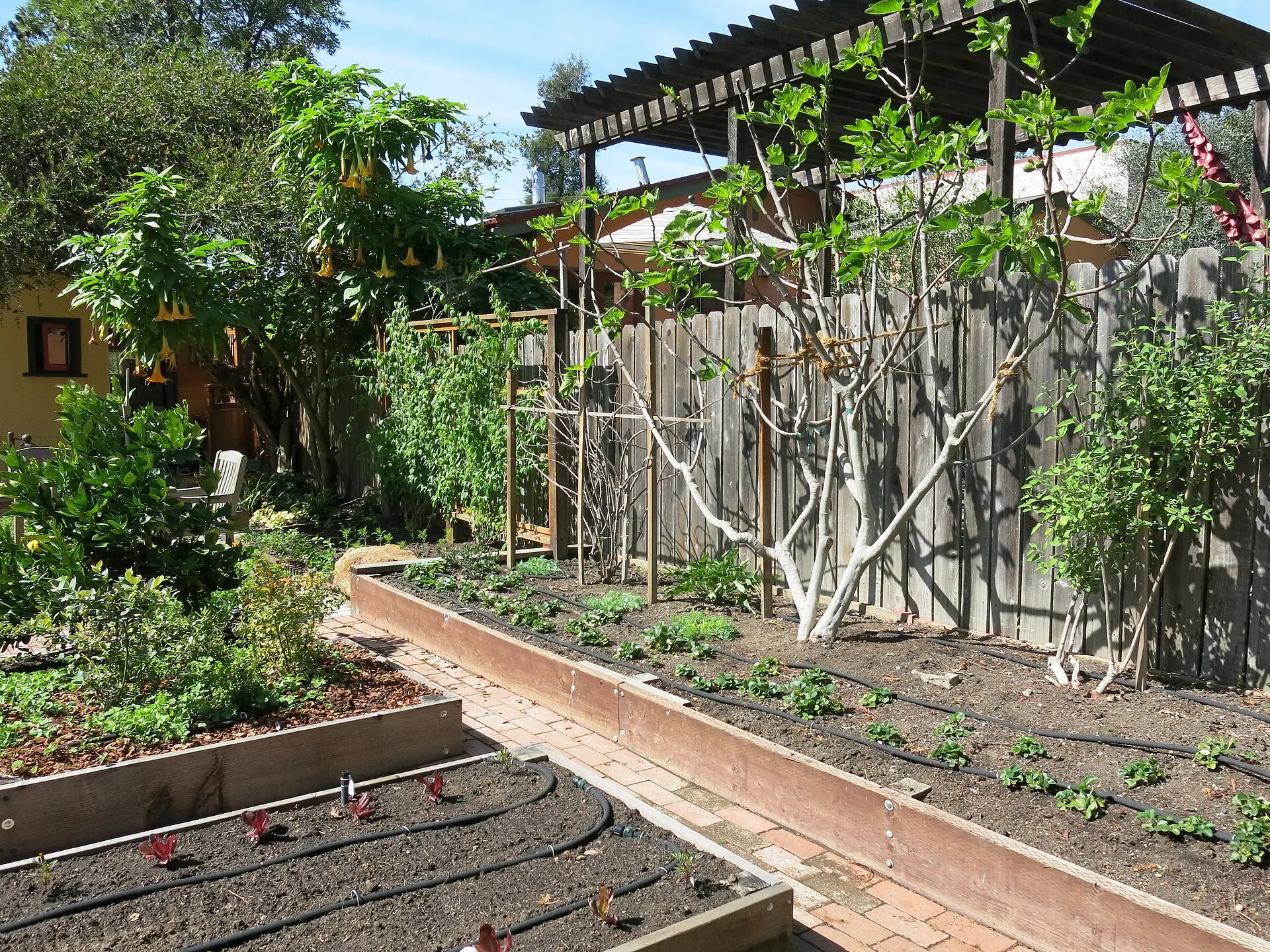

Key points
- 1 inch of water over 1 sq ft is 144 cubic inches, which is 0.623 US gallons; 1 mm over 1 m² is exactly 1 litre.
- Emitters per line = floor(line length / emitter spacing); total flow = emitters x flow per emitter.
- Run time = (water volume / efficiency) / total flow; Oklahoma State Extension gives 90 % application efficiency for a well-designed, maintained drip system.
- University of Arkansas Extension says most fruit and vegetable crops need about 1 to 2 inches of water per week.
- Long single runs can push water below the root zone: split the weekly total into cycles that suit your soil.
What the drip calculator computes
The drip irrigation calculator converts a target depth of water over a raised bed into a run time for your drip system. You enter the bed length and width, the depth of water to apply (in inches or millimetres), the number of drip lines running along the bed, the emitter spacing on those lines, the flow of each emitter and the system efficiency. The tool returns the run time in minutes, plus the intermediate values: bed area, water needed in the root zone, water to apply after efficiency losses, emitter count and total flow.
The defaults describe a 4 x 8 ft bed with three drip lines, emitters every 12 inches at 0.5 gallon per hour (gph), an application of half an inch and 90 % efficiency. Metric defaults are 2.4 x 1.2 m, 12 mm, 30 cm spacing and 2 L/h emitters.
The formulas
The calculator applies five steps, each one a plain multiplication or division.
1. Area
- A = L x W (sq ft or m²)
2. Water needed in the root zone (net volume)
- US units: V_net (gal) = A (sq ft) x depth (in) x 0.623
- Metric: V_net (L) = A (m²) x depth (mm)
3. Water to apply (gross volume)
- V_gross = V_net / e, where e is the application efficiency (0.90 by default)
4. Emitters and total flow
- emitters per line = floor(line length / spacing), with a minimum of 1; lines run along the bed length
- emitters = lines x emitters per line
- Q = emitters x flow per emitter (gph or L/h)
5. Run time
- t (minutes) = V_gross / Q x 60
Where the constants come from
Every constant in the calculator is either a unit conversion or a figure published by an extension service.
0.623 gallons per inch per square foot. One inch of water over one square foot is 12 x 12 x 1 = 144 cubic inches. NIST gives 1 US gallon = 3.785412 x 10⁻³ m³ and 1 cubic inch = 1.638706 x 10⁻⁵ m³, so a gallon is 231 cubic inches, and 144 / 231 = 0.6234 gallons. The USGS figure of 27,154 gallons for one inch of rain on an acre gives the same result: 27,154 / 43,560 sq ft = 0.6234. The calculator uses 0.623.
1 litre per millimetre per square metre. 1 m² x 0.001 m = 0.001 m³, and NIST defines 1 litre as exactly 0.001 m³.
90 % efficiency. Oklahoma State University Extension (fact sheet BAE-1511) states that “a well designed and maintained drip irrigation system is capable of an application efficiency of 90 percent”. The same fact sheet builds this into its own sizing constant: its daily water formula for row crops uses 0.7, described as including 90 % efficiency, which is 0.623 / 0.9 = 0.69 rounded.
Emitter flows. The same Oklahoma fact sheet says most point-source emitters deliver 1/2, 1, 2 or 4 gph at their design operating pressure, and that the emitting devices in line-source drip tubing are typically spaced 6 to 36 inches apart. The calculator accepts any flow; 0.5, 1 and 2 gph (or 1, 2 and 4 L/h in metric) are convenient presets. Note that 2 L/h is about 0.53 gph, not 0.5.
| Constant or setting | Value | Source |
|---|---|---|
| Water per inch per sq ft | 0.623 US gal | NIST conversion factors, USGS cross-check |
| Water per mm per m² | 1 L | NIST (1 L = 0.001 m³) |
| Application efficiency | 90 % default | Oklahoma State Extension BAE-1511 |
| Emitter flow | 0.5 gph default | Oklahoma State Extension BAE-1511 (1/2, 1, 2, 4 gph) |
| Emitter spacing | 12 in default | Within the 6 to 36 in range in BAE-1511 |
| Weekly need (guidance only) | 1 to 2 in | University of Arkansas Extension FSA6174 |
Worked example
This example uses the calculator’s default values so you can check the arithmetic.
Bed: 8 x 4 ft; depth 0.5 in; 3 drip lines along the 8 ft length; emitters every 12 in at 0.5 gph; efficiency 90 %.
- Area: 8 x 4 = 32 sq ft.
- Net water: 32 x 0.5 x 0.623 = 9.97 gal.
- Gross water: 9.97 / 0.9 = 11.08 gal.
- Emitters: 96 in / 12 in = 8 per line; 3 x 8 = 24 emitters.
- Total flow: 24 x 0.5 = 12 gph.
- Run time: 11.08 / 12 = 0.923 h, x 60 = 55 minutes.
With 1 gph emitters the same application takes 28 minutes; with 2 gph emitters, 14 minutes.
Check by application rate. University of Arkansas Extension computes drip rate in inches per hour from flow, emitter spacing and wetted width. For the whole bed: 12 gph x 231 cubic inches per gallon / (32 x 144 sq in) = 0.60 inch per hour. Applying 0.5 / 0.9 = 0.556 inch gross at 0.60 in/h takes 0.92 h, the same 55 minutes.
A week of watering. If the bed needs 1 inch in a week (the low end of the Arkansas range), that is two runs of about 55 minutes, or the equivalent split into shorter cycles.
How to read the result
The run time is the total time to deliver the depth you entered, not a schedule. Whether to apply it in one go or in several cycles depends on your soil. University of Arkansas Extension recommends limiting each irrigation cycle according to the soil’s water-holding capacity: its worked example on sandy loam (0.10 to 0.12 inch of water per inch of soil, 10 inch root zone, irrigation at 25 % depletion) caps a single cycle at 41 to 49 minutes and spreads the weekly total over 5 to 6 runs. Those figures describe field soils; a compost-rich raised bed mix may hold water differently, so check moisture a few inches down after the first runs (Arkansas Extension also suggests a reliable soil moisture sensor). For the practical side of laying lines, see drip irrigation for raised beds; if you would rather store water under the bed, compare with a wicking bed.
The calculator works per bed, not per plant: it does not know how densely you planted or how far the crop has grown. Arkansas Extension notes that growth stage and plant size change water needs, so revisit the depth you enter as the season goes on, and when you change your plant spacing or crops.
Limits
The calculator assumes every emitter delivers its rated flow, which holds only within the emitter’s design pressure; pressure-compensating emitters keep a nearly constant flow over a wider range. It does not subtract rainfall, does not estimate crop water use from weather data, and applies the depth to the whole bed area even if your lines wet only part of it. The 90 % efficiency is the best case for a well-designed, maintained system; clogged emitters, leaks or water running off the surface lower it. The emitter count rounds down to whole emitters per line, so a 100-inch line at 12-inch spacing counts 8 emitters, not 8.3.
Open source code
The calculator is open source under the MIT licence. Its complete JavaScript, including the 0.623 constant and the floor rule for emitters, is published on this page below the article, so you can verify each step, reuse the code or adapt it, keeping the licence notice.
Method and limits
The conversion factors come from NIST SP 811 and are cross-checked against the USGS rain-on-an-acre figure. The efficiency value and the emitter flow and spacing ranges come from Oklahoma State University Extension fact sheet BAE-1511 (revised 2014). The weekly water guidance, the inches-per-hour formula and the per-cycle limit example come from University of Arkansas Extension fact sheet FSA6174 (2026). None of these sources was written specifically for raised beds filled with compost-rich mixes, which is why the result should be confirmed by checking soil moisture.
Calculator source code (MIT)
// The Board Garden - drip irrigation run-time calculator. MIT licence.
// https://theboardgarden.com/tools/drip-irrigation-calculator/
(function () {
  var root = document.querySelector('[data-tool="drip"]');
  if (!root) return;
  var fr = root.dataset.lang === 'fr';
  var f = root.querySelector('form');
  var out = root.querySelector('output');
  var GAL_PER_IN_FT2 = 0.623; // 1 inch of water over 1 ft2 = 0.623 US gal (1 L per mm per m2 in metric)

  function num(name) {
    var v = parseFloat(String(f.elements[name].value).replace(',', '.'));
    return isFinite(v) && v > 0 ? v : 0;
  }
  function fmt(x, d) {
    return x.toLocaleString(fr ? 'fr-FR' : 'en-US', { maximumFractionDigits: d === undefined ? 1 : d });
  }
  function defaults() {
    var metric = f.elements.units.value === 'metric';
    f.querySelectorAll('[data-di]').forEach(function (el) { el.value = metric ? el.dataset.dm : el.dataset.di; });
  }

  function update() {
    var metric = f.elements.units.value === 'metric';
    root.querySelectorAll('[data-u]').forEach(function (el) { el.textContent = metric ? el.dataset.m : el.dataset.i; });
    var L = num('len'), W = num('wid'), depth = num('depth'), rows = Math.round(num('rows'));
    var spacing = num('spacing'), flow = num('flow'), eff = num('eff') / 100;
    if (!(L && W && depth && rows && spacing && flow && eff)) { out.textContent = fr ? 'Saisissez toutes les valeurs.' : 'Enter all values.'; return; }
    // metric: L, W in m; depth mm; spacing cm; flow L/h. imperial: L, W ft; depth in; spacing in; flow gph.
    var area = L * W;
    var net = metric ? area * depth : area * depth * GAL_PER_IN_FT2; // litres or US gallons
    var gross = net / eff;
    var perRow = Math.max(1, Math.floor((metric ? L * 100 : L * 12) / spacing + 1e-9));
    var emitters = rows * perRow;
    var total = emitters * flow; // per hour
    var minutes = (gross / total) * 60;
    var vu = metric ? 'L' : 'gal';
    out.innerHTML =
      '<p><strong>' + (fr ? 'Durée d’arrosage : ' : 'Run time: ') + fmt(minutes, 0) + ' min</strong></p>' +
      '<table><tbody>' +
      '<tr><td>' + (fr ? 'Surface' : 'Area') + '</td><td>' + fmt(area, 2) + (metric ? ' m²' : ' sq ft') + '</td></tr>' +
      '<tr><td>' + (fr ? 'Eau utile' : 'Water needed in the root zone') + '</td><td>' + fmt(net) + ' ' + vu + '</td></tr>' +
      '<tr><td>' + (fr ? 'Eau à apporter (efficience ' : 'Water to apply (efficiency ') + fmt(eff * 100, 0) + ' %)</td><td>' + fmt(gross) + ' ' + vu + '</td></tr>' +
      '<tr><td>' + (fr ? 'Goutteurs' : 'Emitters') + '</td><td>' + rows + ' x ' + perRow + ' = ' + emitters + '</td></tr>' +
      '<tr><td>' + (fr ? 'Débit total' : 'Total flow') + '</td><td>' + fmt(total) + (metric ? ' L/h' : ' gph') + '</td></tr>' +
      '</tbody></table>';
  }
  f.elements.units.addEventListener('change', function () { defaults(); update(); });
  defaults();
  f.addEventListener('input', update);
  f.addEventListener('submit', function (e) { e.preventDefault(); update(); });
  update();
})();
Frequently asked questions
How long should I run drip irrigation in a raised bed?
It depends on the area, the depth of water you want and the total flow of your emitters. For a 4 x 8 ft bed with 24 emitters of 0.5 gph (12 gph in total), applying half an inch at 90 % efficiency takes 32 x 0.5 x 0.623 / 0.9 / 12 = 0.92 hours, about 55 minutes. Doubling the emitter flow halves the time.
How many gallons is one inch of water on a raised bed?
One inch over one square foot is 144 cubic inches, and a US gallon is 231 cubic inches, so it is 0.623 gallons. A 4 x 8 ft bed (32 sq ft) therefore needs 32 x 0.623 = 19.9 gallons for one inch, before allowing for system efficiency. In metric, 1 mm over 1 m² is 1 litre.
How much water does a vegetable raised bed need per week?
University of Arkansas Extension says most fruit and vegetable crops require about 1 to 2 inches of water per week, with seedlings and new transplants needing less and a mature, fruiting tomato plant closer to 2 inches. Warm conditions increase demand and cool, cloudy weather reduces it, so treat the figure as a starting point and check soil moisture.
What does drip irrigation efficiency mean in the calculator?
It is the share of the water leaving the emitters that ends up usable in the root zone. Oklahoma State University Extension states that a well-designed and maintained drip system is capable of an application efficiency of 90 percent, which is the calculator's default. A poorly maintained system with clogged emitters or leaks will do worse; lower the setting if you suspect that.
Sources
- Oklahoma Cooperative Extension Service, Oklahoma State University (2014). Drip Irrigation Systems (BAE-1511)
- University of Arkansas System Division of Agriculture, Cooperative Extension Service (2026). Drip Irrigation Fundamentals: The Math Behind the Drip (FSA6174)
- National Institute of Standards and Technology (2008). NIST Guide to the SI, Appendix B.9: Factors for units listed by kind of quantity or field of science (SP 811)
- U.S. Geological Survey, Water Science School. Water Q&A: How much water falls during a storm?