Raised bed corner joints compared: strength, rot and the fastener rules behind them
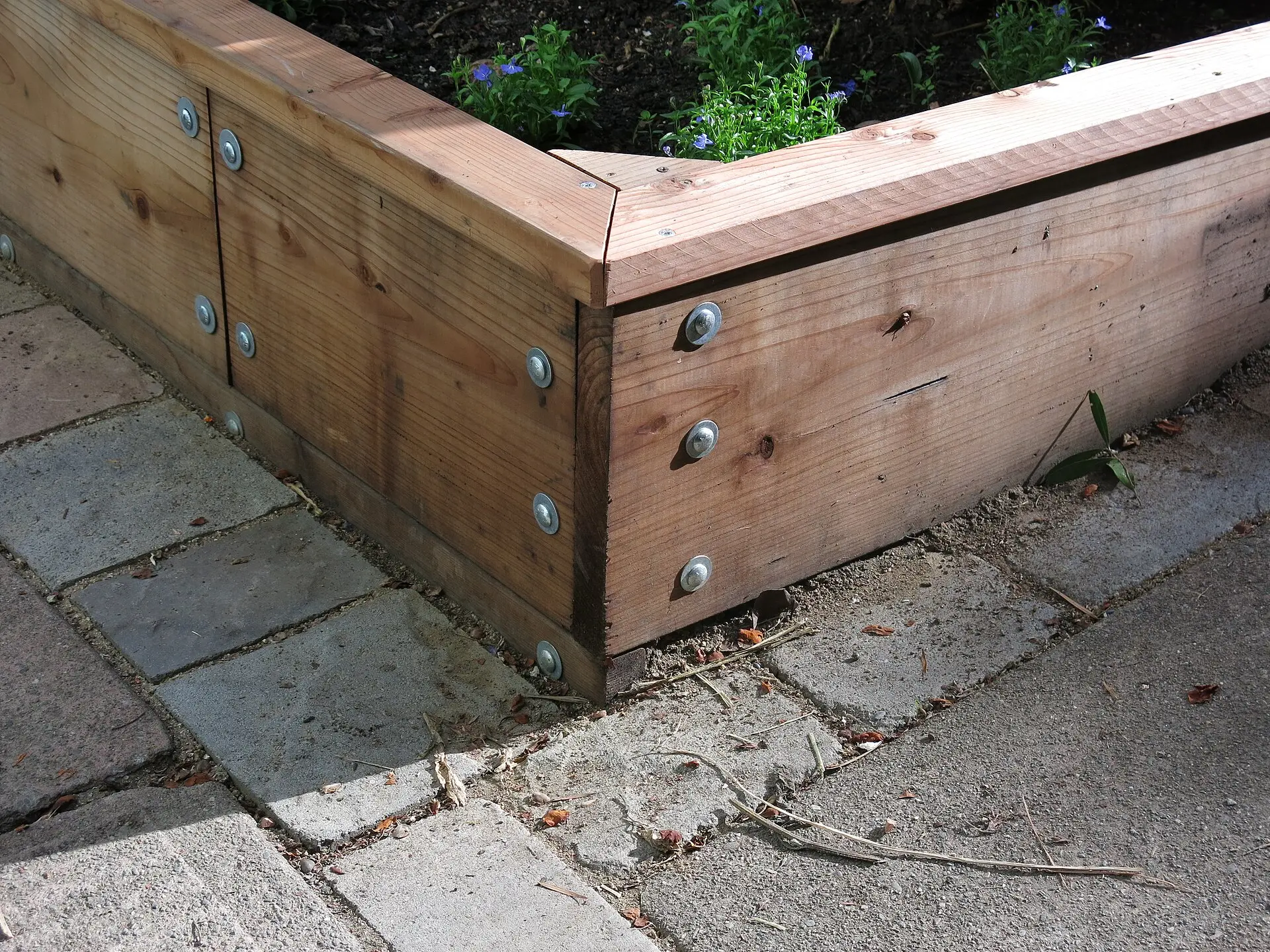
The most dependable raised bed corner is an inside post, such as a 4x4, with every board screwed through its face into the post's side grain. Butt joints screwed into end grain are the weakest option: the USDA Wood Handbook says screws in end grain average only 75% of side-grain withdrawal and are erratic. Brackets, half-laps and through-bolts work too, if fastener distances are respected and cut ends are sealed.

Key points
- Screw withdrawal from end grain averages 75% of side grain and is erratic; nails in end grain keep 50% to 75% (USDA Wood Handbook, chapter 8).
- Lag screws should not be used in end grain at all, according to the same chapter.
- Bolts need an end distance of 7 diameters in softwood (5 in hardwood) when the load pulls toward the end, 4 diameters in compression, and an edge distance of 1.5 diameters.
- End grain absorbs water 10 to 100 times faster than side grain, and the Wood Handbook names sealing it the single most valuable improvement, so every corner design should be judged by how much end grain it exposes.
- Thrive's UK design for softwood beds uses 25 x 150 mm boards on 50 x 50 mm stakes at 1 m centres and caps that design at 450 mm tall.
Why the corner is the weak point of a wooden raised bed
The corner of a raised bed is where the boards of two sides meet, and it is usually the first place a bed opens up, because soil pushes every side outward and the corner fasteners carry that load. It is also where cut ends are concentrated. A corner design therefore has two jobs: keep the fasteners in wood that holds them well, and expose as little end grain as possible to wet soil.
Both jobs come back to the same fact about wood. The USDA Wood Handbook (FPL-GTR-282, 2021) explains in its fastenings chapter that wood screws driven into end grain have an average withdrawal resistance of only 75% of side-grain values, and that results are erratic. Nails driven into end grain keep 50% to 75% of their side-grain withdrawal. The finishing chapter adds that end grain is about 100 times more porous than side grain and takes in liquid water 10 to 100 times faster. A corner that relies on end grain is weaker on day one and wetter afterwards.
Five corner joints compared side by side
The five corner methods commonly used for board-built beds differ mainly in where the fasteners bite and how much end grain stays exposed. The table summarises them; each is explained below.
| Joint | Fasteners work in | End grain exposed | Strength in practice | Rot risk at the corner |
|---|---|---|---|---|
| Butt joint, screwed through one board into the end of the other | End grain of one board | Both board ends | Weakest: 75% of side-grain withdrawal, erratic | High if ends are not sealed |
| Inside corner post (4x4 or 2x4 block) | Side grain only | Board ends hidden against the post; post ends top and bottom | Good, easy to repeat | Post bottom on soil is the risk |
| Metal corner bracket | Side grain only | Board ends meet inside the bracket | Good, square by design | Depends on bracket corrosion |
| Half-lap or notched corner | Side grain, or bolt across both pieces | Notch faces and protruding ends | Good once bolted; half the section removed at the notch | Notch surfaces trap water |
| Log-cabin stacking (alternating overlap) | Side grain if bolted or pinned through the overlap | Every protruding end | Good, looks traditional | Many exposed ends |
Inside corner posts: the default for most home builds
An inside corner post is a short length of square timber, such as a 4x4 (3-1/2 x 3-1/2 in actual), placed in the inside angle of the bed so that both boards can be screwed into it. Every fastener goes through the face of a board into the side grain of the post, which is exactly what the Wood Handbook data favours. This is the method used in our 4x8 build guide.
Two rules from the Wood Handbook’s fastenings chapter set the screw positions. The end distance for a wood screw should be at least the thickness of the side member, and the edge distance at least half of it. With a 2x board (1-1/2 in actual), that means screws at least 1-1/2 in (38 mm) from the board end and 3/4 in (19 mm) from its top and bottom edges. A 4x4 post is wide enough to meet both rules on both boards.
A post can stop at the bottom board, or continue into the ground as a stake. UK charity Thrive’s design for softwood beds takes the stake approach: 25 x 150 mm boards nailed with 60 mm galvanised nails to 50 x 50 x 1000 mm stakes set at 1 m centres, with the lowest board 50 mm below ground, and a maximum height of 450 mm for that type of bed. The trade-off is decay. The Wood Handbook calls ground contact a high decay hazard and recommends treated wood or durable heartwood for posts in ground contact; see which species resist decay.
Metal brackets: quick and square, if the metal lasts
Metal corner brackets hold two boards at a right angle and are screwed into the face of each board, so their fasteners also work in side grain. They make it easy to build several identical beds and to take a bed apart later.
Their lifespan depends on corrosion. Copper-based preservatives are a known concern for fastener corrosion, and the Wood Handbook reports that 300 series stainless steel performs well in wood treated with CCA, ACA, copper azole and ACQ, and that galvanized coatings are applied for corrosion resistance. The guide to screws for raised beds covers coatings and stainless grades in detail.
Half-laps and log-cabin stacking: traditional, but more end grain
A half-lap corner removes half the height or thickness of each board at the joint so the two pieces overlap and interlock; log-cabin stacking lets the boards of alternate courses run past the corner, like the logs of a cabin. Both look good and both can be very rigid once a bolt or long screw passes through the overlap.
Their cost is end grain and water. Each notch creates fresh cut faces, and each protruding board end is a piece of end grain facing the weather. The Wood Handbook’s preservatives chapter singles out exposed end grain in joints and the areas around fasteners as places that need on-site treatment, and recommends treating cut surfaces of treated wood, for example with a copper naphthenate product at 1% to 2% copper. Removing half the section at a notch also halves the board there, which matters more with thin boards; the board thickness guide explains why thickness limits span.
Through-bolts: the spacing rules that make them work
A through-bolt passes all the way through the boards (and a post, if there is one) and is tightened with a washer and nut, so it cannot pull out of end grain the way a screw can. Bolts need more room than screws, and the Wood Handbook gives explicit spacing in bolt diameters (D).
| Rule (Wood Handbook, chapter 8) | Multiple of bolt diameter | 3/8 in bolt | 1/2 in bolt |
|---|---|---|---|
| End distance, softwood, load toward the end (tension) | 7D | 2-5/8 in (67 mm) | 3-1/2 in (89 mm) |
| End distance, hardwood, tension | 5D | 1-7/8 in (48 mm) | 2-1/2 in (64 mm) |
| End distance, compression | 4D | 1-1/2 in (38 mm) | 2 in (51 mm) |
| Spacing between bolts along the grain | 4D | 1-1/2 in (38 mm) | 2 in (51 mm) |
| Edge distance | 1.5D | 9/16 in (14 mm) | 3/4 in (19 mm) |
In a raised bed, soil pushes the side outward, which pulls a corner bolt toward the end of the board, so the tension end distance is the one to respect. If you use lag screws instead of bolts, the same chapter is clear: lag screws should not be used in end grain, and lead holes should be drilled at 60% to 75% of the shank diameter for Douglas-fir and Southern Pine, 40% to 70% for cedars, and 65% to 85% for oaks.
Keeping any corner dry and sound for longer
Whatever joint you choose, the corner lasts longer if it dries out between wettings. The Wood Handbook’s biodeterioration chapter explains that serious decay happens only above fibre saturation (about 30% moisture content on average), and that air-dry wood at 20% or less is safe. The finishing chapter names end grain on bottom surfaces as a problem area.
Three practical consequences follow from those sources:
- Seal every cut end before assembly, including notches and bolt holes.
- Keep the bottom end grain of posts off wet soil where possible, or use treated or naturally durable heartwood for posts in ground contact (see pressure-treated wood in vegetable gardens).
- Use thicker boards or add a mid-side post on long sides: UGA Extension notes that 1-in lumber needs a vertical support about every 4 ft, so corner strength alone cannot hold a thin, long side straight.
Method and limits
This comparison rests on the USDA Wood Handbook (2021) chapters on fastenings, finishing, preservatives and biodeterioration, on Thrive’s 2008 raised bed construction leaflet and on UGA Extension circular C 1027-4. The bolt and screw distances are general timber engineering rules, not values tested on garden beds. None of the sources rank the five corner joints against each other with measured data on soil-filled beds, so the “strength in practice” column is our reading of the fastener data, not a test result. Lifespans in years are not given because no source we opened measured them for these joints.
Frequently asked questions
What is the strongest way to join raised bed corners?
An inside corner post with screws or bolts driven through each board into the post's side grain is the most dependable choice for a home-built bed, because every fastener works in side grain. Through-bolts with washers are stronger still in withdrawal, provided they sit at least 7 bolt diameters from the board end in softwood, as the USDA Wood Handbook recommends for loads pulling toward the end.
Can I just screw raised bed boards together at the corners?
You can, but a butt joint screwed into the end of the other board is the weakest option. The USDA Wood Handbook reports that screw withdrawal from end grain averages only 75% of side-grain values and is erratic, and that end grain also absorbs water 10 to 100 times faster. Adding a block or post inside the corner moves the screws into side grain.
Are metal corner brackets good for raised beds?
Metal brackets give a square, repeatable corner and put screws into side grain, which is good. Their weak point is corrosion, especially in copper-treated lumber. The Wood Handbook notes that 300 series stainless performs well in copper azole and ACQ-treated wood, while galvanized coatings are the usual corrosion protection for exterior fasteners.
Should raised bed corner posts go into the ground?
Posts driven into the ground stiffen a bed and stop it from shifting, which is why Thrive's design uses stakes at 1 m centres and sets the lowest board 50 mm below ground. But anything in ground contact faces the highest decay hazard, and the USDA Wood Handbook recommends treated wood or durable heartwood for posts in ground contact.
Sources
- USDA Forest Service, Forest Products Laboratory (2021). Wood Handbook (FPL-GTR-282), chapter 8: Fastenings
- USDA Forest Service, Forest Products Laboratory (2021). Wood Handbook (FPL-GTR-282), chapter 16: Finishing of Wood
- USDA Forest Service, Forest Products Laboratory (2021). Wood Handbook (FPL-GTR-282), chapter 15: Wood Preservatives
- USDA Forest Service, Forest Products Laboratory (2021). Wood Handbook (FPL-GTR-282), chapter 14: Biodeterioration of Wood
- Thrive (Society for Horticultural Therapy) (2008). How to build raised beds
- University of Georgia Cooperative Extension (2022). Raised Garden Bed Dimensions (Circular 1027-4)