Accessible raised bed height and width: numbers for wheelchair users, seated and standing gardeners
For a wheelchair user working from the side, a solid raised bed about 24 inches (615 mm) high and no more than 2 ft deep from each accessible edge works well; Thrive and UGA Extension both give about 24 inches. Seated gardeners on a chair suit 27 to 30 inches, standing gardeners 35 to 39 inches. Table beds need knee space at least 27 inches high underneath, following ADA clearances.

Key points
- Thrive (UK) recommends 900 to 1000 mm (35 to 39 in) for standing gardeners, 690 to 760 mm (27 to 30 in) for seated, and 615 mm (24 in) for wheelchair users, with beds 500 mm (20 in) wide when reached from one side.
- UGA Extension gives 24 in tall for wheelchair access and 3 ft wide for adults (2 ft for children); Oregon State recommends paths 3 to 4 ft wide.
- ADA 2010 side reach over an obstruction allows a 34 in high, 24 in deep obstruction with a 46 in maximum reach height, which fits a bed about 2 ft deep.
- ADA knee clearance is 27 in high, 30 in wide and up to 25 in deep; a table bed with 10 in of soil above that clearance ends up well above the 28 to 34 in ADA work surface range.
- Accessible routes need at least 36 in clear width, running slopes no steeper than 1:20 and firm, stable, slip-resistant surfaces (ADA 2010).
Accessible bed heights in one table
An accessible raised bed is sized around the person using it: their working height, how far they can reach, and whether they need room for their knees under the bed. The most detailed garden-specific numbers come from Thrive, the UK horticultural therapy charity, and from US extension services; building codes such as the ADA 2010 Standards add reach and clearance data, although they do not contain a raised bed specification.
| Gardener | Bed height | Bed width | Source |
|---|---|---|---|
| Standing | 900 to 1000 mm (35 to 39 in) | 500 mm (20 in) from one side | Thrive (2008) |
| Standing, no bending | 36 in (914 mm); “3 ft or more” for easy-access beds | Up to 4 ft adults, 3 ft children | UGA C 1027-4; Oregon State EM 9403 |
| Seated on a chair or stool | 690 to 760 mm (27 to 30 in) | 500 mm (20 in) from one side | Thrive (2008) |
| Wheelchair user, side approach | 615 mm (24 in) | 500 mm (20 in) from one side, up to 1000 mm (39 in) from both | Thrive (2008) |
| Wheelchair user | 24 in (610 mm) | 3 ft adults, 2 ft children | UGA C 1027-4 |
| Wheelchair user | About 2 ft, or about 3 ft on legs with room beneath | Not more than 4 ft adults, 3 ft children | Oregon State EM 9403 |
The sources agree closely on about 24 in (610 to 615 mm) for a solid bed worked from a wheelchair, and on about 3 ft (900 mm or more) for standing gardeners. Where they differ is width, because width depends on whether the bed can be reached from one side or both.
Width comes from reach, not from lumber
The width of an accessible bed is set by how far a seated person can reach, which is shorter than a standing adult’s reach. Thrive gives 500 mm (about 20 in) for beds reached from one side and up to 1000 mm when the bed can be worked from both sides. UGA Extension gives 3 ft for adults and 2 ft for children in wheelchair beds, compared with 4 ft and 3 ft for ordinary beds.
The ADA 2010 Standards help explain these figures. They are written for buildings and fixtures, not gardens, but their reach ranges describe what a seated adult can do:
| ADA 2010 provision | Requirement |
|---|---|
| 308.2.1 Unobstructed forward reach | High 48 in (1220 mm) max, low 15 in (380 mm) min |
| 308.2.2 Obstructed forward reach | 48 in max high reach if reach depth is 20 in (510 mm) or less; 44 in (1120 mm) max for reach depth over 20 in, up to 25 in (635 mm) |
| 308.3.1 Unobstructed side reach | High 48 in max, low 15 in min; obstruction up to 10 in (255 mm) deep allowed |
| 308.3.2 Obstructed side reach | Obstruction max 34 in (865 mm) high and 24 in (610 mm) deep; high reach 46 in (1170 mm) max at 24 in depth |
| Advisory 308.1, children | Ages 3-4: 36 in high, 20 in low; ages 5-8: 40 in / 18 in; ages 9-12: 44 in / 16 in |
Read as a garden rule of thumb, side reach over an obstruction up to 34 in high and 24 in deep is consistent with a 24-in-high bed about 2 ft deep from the edge where the wheelchair parks. That matches UGA’s 3-ft adult width only if the bed is reachable from both sides, and Thrive’s 500 mm one-side width with room to spare.
Solid beds versus table beds with knee space
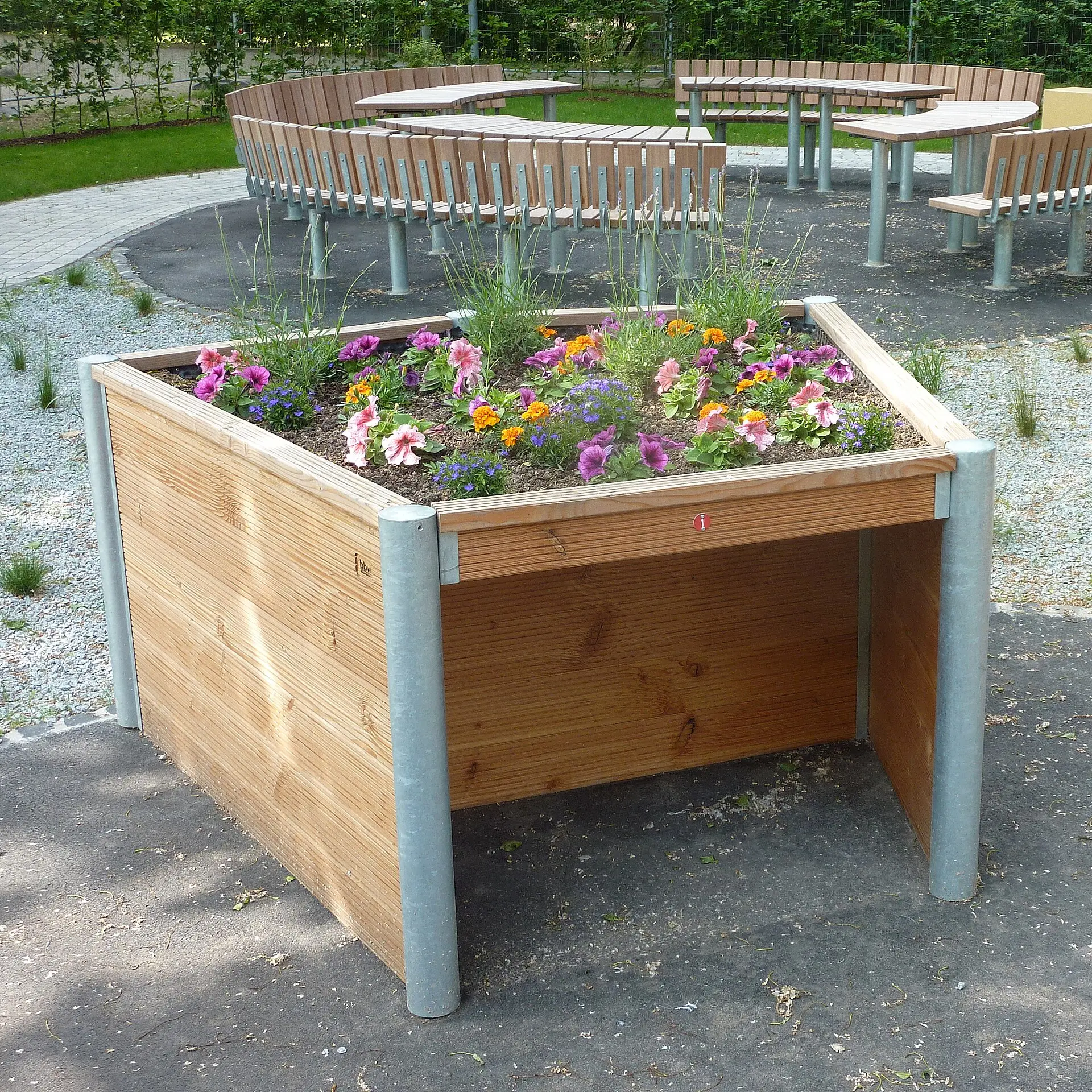
There are two ways to bring soil within reach of a seated gardener: a solid bed at about 24 in, worked from the side, or a table bed on legs that a wheelchair can roll under. Oregon State’s EM 9403 describes both: beds about 2 ft high, or elevated to 3 ft on legs with room underneath for the mobility aid.
A table bed has to leave real knee space. ADA 2010 section 306 defines knee clearance as space between 9 and 27 in (230 to 685 mm) above the floor, at least 30 in (760 mm) wide and up to 25 in deep, with at least 11 in of depth at 9 in high and 8 in at 27 in high; toe clearance runs from the floor to 9 in. Section 902.3 places accessible work surfaces 28 to 34 in (710 to 865 mm) high.
Those two numbers create a tension. If the underside of the planter is at 27 in and it holds 10 in of soil (the depth UGA gives for elevated planters), plus a bottom of about 1-1/2 in, the soil surface sits around 38-1/2 in, above the 34 in maximum for work surfaces. Table beds therefore trade soil depth for knee space, and are best for shallow-rooted crops; see how deep a raised bed needs to be for crop depths.
| Design | Typical height | Soil depth | Approach | Trade-off |
|---|---|---|---|---|
| Solid bed, wheelchair | About 24 in (610 mm) | Full height | Side approach | Reach limited to about 2 ft |
| Solid bed, seated on chair | 27 to 30 in | Full height | Seated, side | Needs a seat and room to swing legs |
| Solid bed, standing | 35 to 39 in | Full height | Standing | Large soil volume, strong sides needed |
| Table bed on legs | Underside at 27 in or more | About 10 in | Forward approach, knees under | Shallow soil, heavier frame loads on legs |
Paths, turning space and surfaces around the beds
A bed is only accessible if the person can get to it and turn around. The ADA 2010 Standards require a clear floor space of 30 x 48 in (760 x 1220 mm) at each element, a turning space of a 60 in (1525 mm) circle or a T-shape within a 60 in square, and accessible routes at least 36 in (915 mm) wide. Running slopes may be no steeper than 1:20 and cross slopes no steeper than 1:48; ramps no steeper than 1:12. Surfaces must be stable, firm and slip resistant.
Garden sources say the same thing in garden terms. Oregon State’s EM 9403 recommends paths 3 to 4 ft wide and notes that hard-paved surfaces such as concrete or asphalt give reliable accessibility. UGA Extension recommends 4-ft paths where carts and wheelchairs pass. Beds placed on paving raise their own questions of drainage and depth, covered in raised beds on concrete.
Building a 24-inch bed
A 24-in solid bed can be built with the same method as a standard bed, using more or wider courses. With 2x12 lumber (11-1/4 in actual), two courses give 22-1/2 in, and a flat 2x cap board (1-1/2 in thick) on top brings the edge to exactly 24 in while giving a place to rest forearms or tools. With 2x10 (9-1/4 in actual), three courses give 27-3/4 in, closer to Thrive’s seated range. The construction steps are in the 4x8 build guide; for a bed reached from one side, narrow it to about 2 ft rather than 4 ft.
A taller bed holds more soil, which means more weight against the sides and more watering. A drip line saves carrying water to the far side of the bed; see drip irrigation for raised beds.
Method and limits
Heights and widths come from Thrive’s 2008 leaflet, UGA Extension circular C 1027-4 and Oregon State University Extension EM 9403 (2023). Reach, clearance, route and surface figures come from the 2010 ADA Standards, which apply to buildings and facilities and do not specify garden beds; using them for beds is our interpretation. The table bed height calculation is our arithmetic. We did not find an authoritative source giving a general 24 to 30 in height range for wheelchair beds beyond the figures above, and individual needs vary widely: a gardener’s own reach and seat height should override any table.
Frequently asked questions
What height should a raised bed be for a wheelchair user?
About 24 inches. UGA Extension says beds for wheelchair access should be 24 inches tall, and the UK charity Thrive gives 615 mm, which is the same height. At that height a wheelchair user can work from the side, reaching over the bed edge. Table beds with knee space underneath are an alternative and must be taller to clear the knees.
How wide should an accessible raised bed be?
Narrow enough to reach the middle from the seat. Thrive recommends 500 mm (about 20 inches) for a bed reached from one side and up to 1000 mm when reachable from both sides. UGA Extension suggests 3 ft for adults and 2 ft for children in wheelchair beds, and ADA side reach rules allow reaching about 24 inches over a 34-inch-high obstruction.
How much knee space does a table raised bed need?
The ADA 2010 Standards define knee clearance as space at least 27 inches high and 30 inches wide, up to 25 inches deep, with toe clearance below 9 inches. A table bed that leaves that space and holds 10 inches of soil, the depth UGA gives for elevated planters, has a top surface well above 27 inches, so check reach before choosing its height.
What is a comfortable raised bed height for standing?
Thrive recommends 900 to 1000 mm, about 35 to 39 inches, for gardeners who work standing. UGA Extension notes that a 36-inch bed avoids bending, and Oregon State University Extension describes easy-access beds as 3 feet or more high. Taller beds need more soil and stronger sides, which is why table designs on legs are an option at this height.
Sources
- U.S. Access Board / U.S. Department of Justice (2010). 2010 ADA Standards for Accessible Design
- Thrive (Society for Horticultural Therapy) (2008). How to build raised beds
- Oregon State University Extension Service (2023). Gardens are for everyone (EM 9403)
- University of Georgia Cooperative Extension (2022). Raised Garden Bed Dimensions (Circular 1027-4)