Wicking bed: how deep the reservoir and soil should be, and how to build one in a wooden frame
A wicking bed is a lined raised bed with a water reservoir of gravel or scoria under the soil, fed by a fill pipe and capped by an overflow. Water rises by capillarity, which Sustainable Gardening Australia limits to about 12 inches (300 mm), so keep the soil layer near 12 in. A University of South Australia trial found 12 in of soil beat 24 in.
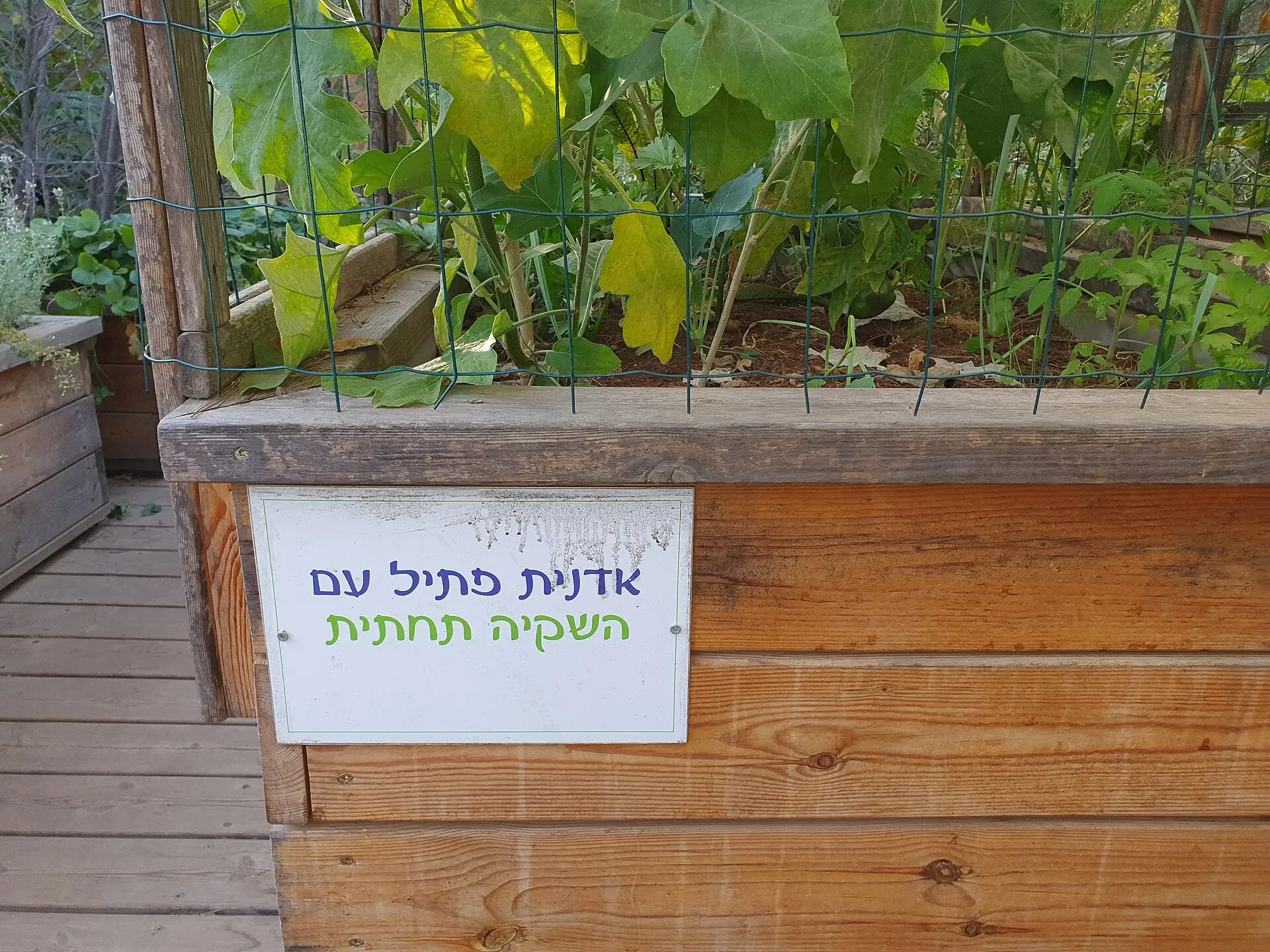

Key points
- Capillary rise limits the useful soil depth: Sustainable Gardening Australia states water cannot be wicked further than 300 mm (12 in).
- In a 2016 tomato trial (Semananda, Ward and Myers), 300 mm of soil outperformed 600 mm, and reservoir depth (150 vs 300 mm) made no difference.
- The overflow outlet sets the maximum water level; place it at the top of the reservoir layer so the soil above never waterlogs.
- The liner must be continuous and the bed must sit level, or water pools at one end.
- Recycled or salty water can build salts in the surface layer, because water moves upward and evaporates (Semananda et al., 2021).
What a wicking bed is and how it works
A wicking bed is a raised bed with a sealed water reservoir in its base, so plants draw water upward through the soil instead of receiving it from above. The University of South Australia team that has published most of the research describes it as a system in which “plants receive water through capillary rise from a self-contained coarse material-filled subsoil reservoir” (Semananda, Ward and Myers, 2016). Sustainable Gardening Australia credits the design to the Australian engineer Colin Austin.
The working parts are the same in every version:
- A waterproof liner (pond liner or heavy builders’ plastic) that turns the bottom of the bed into a tank.
- A reservoir layer of coarse material such as scoria, gravel or slotted agricultural pipe, which holds water in its pore space.
- A fill pipe, usually vertical PVC, that delivers water straight into the reservoir.
- A separating layer (geotextile or shade cloth) that stops soil washing down into the gravel.
- An overflow outlet that fixes the maximum water level and stops the soil above from waterlogging.
- The growing soil, which must be fine and porous enough to wick.
Because water enters at the bottom and moves upward, the soil surface stays drier than in a top-watered bed, and less water is lost to deep drainage. That is the whole case for the design: fewer, larger fills instead of frequent watering.
The 12-inch rule: why soil depth is limited by capillary rise
The single most important number in wicking bed design is the height water can climb through the soil, which Sustainable Gardening Australia (SGA) puts at about 300 mm (12 in). Its handout states plainly that “water cannot be wicked further than 300mm”. Roots above that height sit in soil that the reservoir cannot reach.
Field data support keeping the soil shallow. In the 2016 Horticulturae trial with tomatoes, beds with 300 mm (12 in) of soil outperformed beds with 600 mm (24 in). The same trial found no difference between a 150 mm (6 in) and a 300 mm (12 in) reservoir. A separate trial published in the Journal of Applied Horticulture in 2023 compared reservoirs of 100 and 150 mm with soil of 200 and 300 mm, with and without a coir geotextile, and recommended 150 mm of reservoir, 300 mm of soil and a geotextile interlayer.
| Design variable | Values compared | Result | Source |
|---|---|---|---|
| Soil depth | 300 mm (12 in) vs 600 mm (24 in) | 300 mm performed better | Semananda et al. 2016 |
| Reservoir depth | 150 mm (6 in) vs 300 mm (12 in) | No difference | Semananda et al. 2016 |
| Reservoir depth | 100 mm (4 in) vs 150 mm (6 in) | 150 mm recommended | Greeshma et al. 2023 |
| Soil depth | 200 mm (8 in) vs 300 mm (12 in) | 300 mm recommended | Greeshma et al. 2023 |
| Interlayer | With vs without coir geotextile | Geotextile recommended | Greeshma et al. 2023 |
| Maximum wicking height | Not tested; guidance figure | About 300 mm (12 in) | SGA handout |
This is why a wicking bed is not simply a deep raised bed with water underneath. For crops that root deeply, see how deep a raised bed should be: a wicking bed trades depth for automatic watering.
Recommended layer stack for a 24-inch wicking bed
A complete wicking bed following the SGA handout is about 600 mm (24 in) deep, split into a 300 mm (12 in) saturated zone and a 300 mm (12 in) growing zone. Read from the bottom up:
| Layer | Thickness | Material | Notes |
|---|---|---|---|
| Sand bed (if on soil) | Thin, to smooth the base | Sand | Protects the liner from tears |
| Liner | Continuous | Pond liner or builders’ plastic | Runs up the walls at least to the overflow |
| Reservoir | 150 mm (6 in) | Scoria or gravel around slotted ag pipe | Inlet pipe connects to the slotted pipe |
| Separator | One layer | Geotextile or shade cloth | Shade cloth lets some soil through |
| Lower soil (wet zone) | 150 mm (6 in) | Growing mix | Overflow sits at 300 mm, the top of this zone |
| Upper soil (root zone) | 300 mm (12 in) | Half mushroom compost, half organic soil mix | SGA advises against clay garden soil |
| Mulch | 5 to 7 cm (2 to 3 in) | Straw | Cuts surface evaporation |
The SGA handout specifies 50 mm (2 in) PVC for the vertical inlet, a 90-degree elbow onto 50 mm slotted agricultural pipe laid along the centre of the bed, and an end cap on the far end of the slotted pipe. The overflow, for example a tank outlet tap, goes on the end opposite the inlet at 300 mm height. If you build on bare ground, SGA says to dig a level hole 150 mm (6 in) deep first.
Building one inside a wooden board frame
A wooden raised bed works as a wicking bed frame as long as the liner, not the wood, holds the water. Practical points for timber frames:
- Size the frame. For the layer stack above you need about 24 in (600 mm) of internal height. Three courses of 2x8 (38 x 184 mm actual) give 21.75 in (552 mm); four courses of 2x6 (38 x 140 mm actual) give 22 in (560 mm). If the frame is lower than 24 in, cut the lower soil layer, not the 12 in root zone. Our step-by-step 4x8 raised bed build covers the frame itself.
- Level the site. SGA stresses that the bed must be level, because the reservoir is a flat pool. A bed that slopes leaves the high end dry.
- Line it in one piece. Fold corners rather than cutting them. Fix the liner to the top board, not through the wall below the overflow line, or every screw becomes a leak. The general pros and cons of liners against wood are covered in should you line a raised bed.
- Fit the overflow. Drill one board at the top of the reservoir layer and fit a sealed outlet through the liner. This hole sets the water level for the life of the bed.
- Lay the reservoir. Place the slotted pipe, connect the vertical inlet, then fill around it with gravel or scoria to 150 mm (6 in).
- Add the separator. The Botanic Gardens of Sydney recommends tucking the geotextile or shade cloth down the sides so soil cannot slip around its edges.
- Fill with soil and wet it. Fill with a porous, loamy mix. The Sydney guide says to fill the reservoir until water flows from the overflow, then water from above for one to two weeks while roots establish.
Bed volume grows fast in a wicking bed. A 4x8 ft bed at 24 in deep holds 64 cu ft (1.8 m3) of material in total, half of it soil, so plan the fill before buying. For the soil itself, the guidance in our raised bed soil mix page applies, with one change: choose a mix that wicks, not a very coarse, fast-draining one.
How much water the reservoir holds: a worked calculation
Reservoir capacity depends on the void space in your gravel, and that varies by grading and shape, so measure it rather than trusting a generic figure. The method takes ten minutes:
- Fill a bucket of known volume (say 10 L, 2.6 US gal) to the brim with your dry gravel or scoria.
- Pour in water from a measuring jug until it just reaches the top of the stones.
- Divide the water added by the bucket volume. This ratio is the porosity, p.
Then compute storage for the bed:
- Reservoir volume = bed area x reservoir depth.
- For a 4x8 ft bed with a 6 in reservoir: 32 sq ft x 0.5 ft = 16 cu ft.
- 16 cu ft x 28.32 L per cu ft = 453 L (about 120 US gal) of gravel.
- Water stored = 453 L x p.
If your bucket test gave p = 0.30 (an illustrative value, not a standard figure), the gravel layer stores about 136 L (36 US gal). The soil in the saturated zone holds extra water on top of that, which is harder to estimate and better treated as a safety margin. SGA suggests filling to about 200 mm (8 in) and using a dipstick in the inlet pipe to see when to refill.
What the research says about yield and water savings
Peer-reviewed work on wicking beds is still thin, and most of it comes from one research group in South Australia. Here is what has been measured:
- 2016 tomato trial (Horticulturae): wicking beds performed as well as or better than precision surface-irrigated pots, with significant improvements in water use efficiency, yield and fruit quality, and they needed less frequent watering, so they were more labour-efficient.
- 2018 review (Horticulturae): the authors found no published research giving design recommendations for wicking beds and described a substantial knowledge gap.
- 2021 recycled water study (Earth): wicking beds performed similarly to or better than surface irrigation with fresh water and reduced nutrient leaching, but salt accumulation and the sodium absorption ratio were high in the surface layer compared with surface irrigation.
The Botanic Gardens of Sydney states that wicking beds use “up to 50% less water than a conventional garden bed”. That is an upper bound from a public garden guide, not a trial result, and actual savings depend on climate, mulch and crop.
The salt finding matters if you fill with greywater, rainwater stored in contact with concrete, or hard mains water. Water travels upward and evaporates at the surface, leaving dissolved salts behind. The studies above did not test remedies, so watch for white crusting or leaf-edge burn and test the soil if you see either.
When a wicking bed is the wrong choice
A wicking bed suits hot, dry climates, gardeners who cannot water daily, and beds on hard surfaces where drainage is not possible anyway. It is a poor fit in some cases:
- Deep-rooted crops that need more than 12 in of rooting depth will not get the full benefit.
- Very wet climates: in long rainy spells the overflow handles excess water, but the lower soil stays saturated.
- Sloping sites: the reservoir needs a level base; a stepped or terraced frame is required.
- Salty water sources: see the salt accumulation finding above.
If you only want to cut watering labour, a timer-driven system may be simpler; see drip irrigation for raised beds for flow and spacing figures.
Method and limits
This page combines three peer-reviewed trials and one review from the University of South Australia group, one independent trial from India, and construction guidance from Sustainable Gardening Australia and the Botanic Gardens of Sydney. The trials used tomatoes in controlled settings; results for other crops and climates are not established. The 300 mm wicking limit is a practitioner guidance figure rather than a measured constant, and capillary rise varies with soil texture. No verified figure for gravel or scoria porosity was found, which is why the article gives a measurement method instead of a number.
Frequently asked questions
How deep should the soil be in a wicking bed?
About 12 inches (300 mm). Sustainable Gardening Australia states that water cannot be wicked further than 300 mm, and the 2016 University of South Australia tomato trial found 300 mm of soil performed better than 600 mm. Deeper soil leaves the upper roots beyond the reach of capillary rise, so the top dries out like an ordinary bed.
How deep should the water reservoir be?
Around 6 inches (150 mm) of gravel or scoria is enough for most garden beds. In the Semananda 2016 trial, a 150 mm reservoir performed the same as a 300 mm one. An Indian trial published in 2023 also recommended a 150 mm reservoir with 300 mm of soil and a geotextile between the layers.
Do wicking beds really save water?
The evidence is limited but positive. The 2016 Horticulturae trial reported significantly higher water use efficiency than precision surface-irrigated pots, and the Royal Botanic Garden Sydney says wicking beds can use up to 50% less water than a conventional bed. A 2018 review noted that design research is still scarce.
Can I build a wicking bed inside a wooden raised bed?
Yes, provided the inside is fully lined with pond liner or heavy builders' plastic so the reservoir holds water. The liner runs up the walls at least to the overflow height. The wood frame then carries the soil load, and the outlet pipe passes through one board at the top of the reservoir layer.
Why are my wicking bed plants wilting even though the reservoir is full?
The usual causes are soil that is too deep for capillary rise, a coarse or clay-heavy mix that wicks poorly, or a bed that is not level so part of the reservoir is dry. New beds also need watering from above for the first week or two until roots reach the moist zone.
Sources
- Horticulturae 2(4):13, Semananda, Ward and Myers, University of South Australia (2016). Evaluating the Efficiency of Wicking Bed Irrigation Systems for Small-Scale Urban Agriculture
- Horticulturae 4(3):23, Semananda, Ward and Myers (2018). A Semi-Systematic Review of Capillary Irrigation: The Benefits, Limitations, and Opportunities
- Earth 2(3):28, Semananda, Ward and Myers (2021). Assessing Reliability of Recycled Water in Wicking Beds for Sustainable Urban Agriculture
- Journal of Applied Horticulture 25(2), Greeshma et al. (2023). Influence of wicking bed system characteristics on tomato (Solanum lycopersicum L.) growth and yield
- Sustainable Gardening Australia (2020). Wicking Beds (handout)
- Botanic Gardens of Sydney (Royal Botanic Garden Sydney) (2023). Building a wicking bed