Best wood for raised garden beds: how the common species actually compare
The best untreated woods for raised beds are species whose heartwood the USDA Wood Handbook rates as very resistant or resistant to decay: black locust, Osage-orange, the cedars, junipers, white oaks, old-growth redwood and baldcypress. Douglas-fir, larch and young-growth redwood are only moderately resistant, and most pines, spruces and firs are slightly or nonresistant. Sapwood of every species rots quickly.
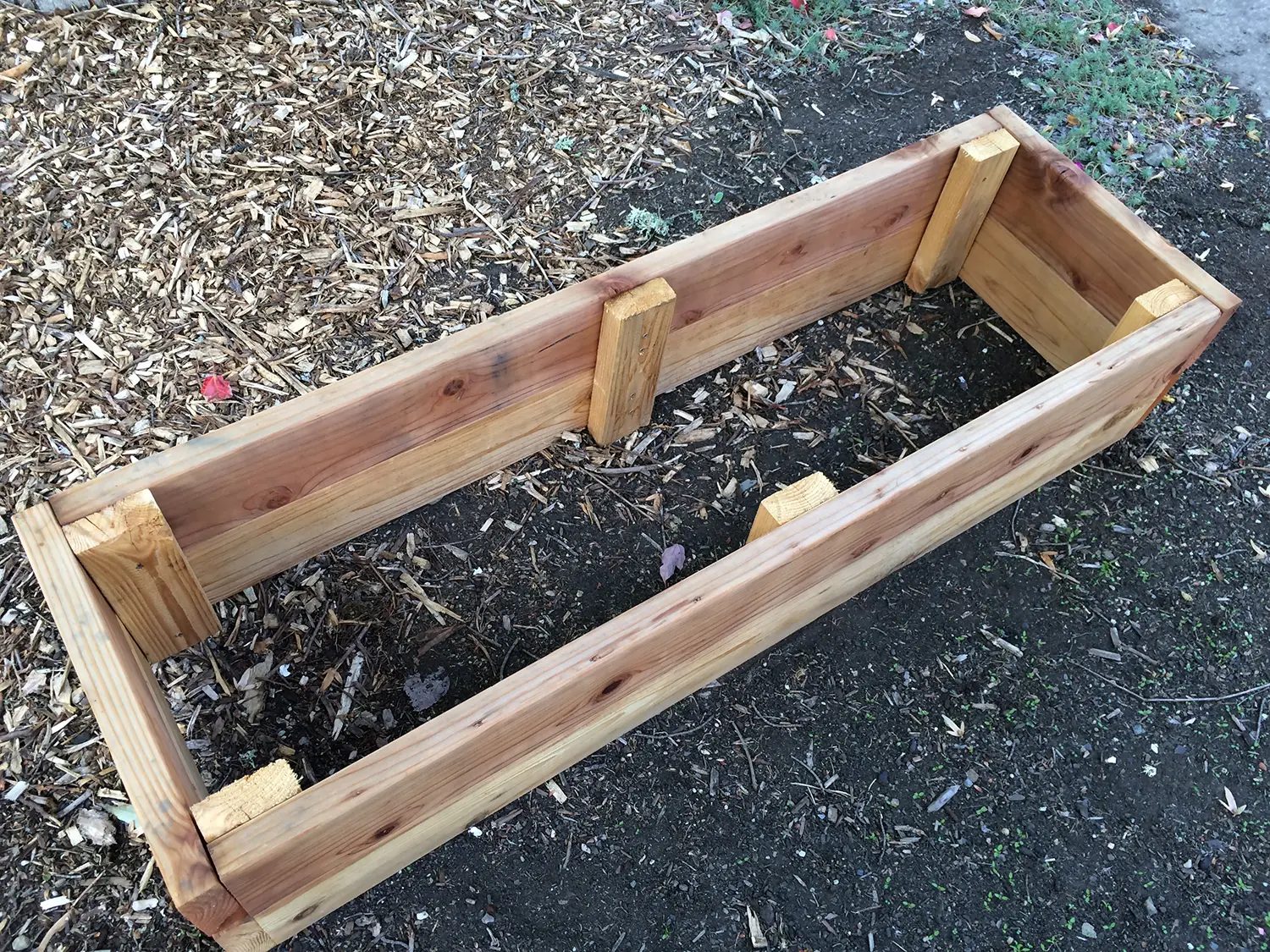

Key points
- Decay resistance belongs to heartwood only: untreated sapwood of essentially all species has low resistance (USDA Wood Handbook, ch. 14).
- Very resistant: black locust, Osage-orange, red mulberry. Resistant: cedars, junipers, white oaks, black walnut, old-growth redwood and baldcypress.
- Douglas-fir, western larch and young-growth redwood are moderately resistant; most other pines, spruces, true firs and hemlocks are slightly or nonresistant.
- In an Oregon State University trial, untreated Douglas-fir beds were badly decayed after 6 seasons while ground-contact treated beds were mostly intact.
- Cedar and redwood cost more than pine and fir; the cheaper woods last longer only if treated.
The short ranking: heartwood decay classes from the USDA Wood Handbook
The most reliable way to compare woods for a raised bed is the natural decay resistance of their heartwood, as grouped in Table 14-1 of the USDA Forest Products Laboratory Wood Handbook (FPL-GTR-282, 2021). The table puts species into four classes: very resistant, resistant, moderately resistant, and slightly or nonresistant. A raised bed side is a hard case for wood: one face is pressed against moist soil all season, and the bottom edge usually sits on the ground. That is exactly the “ground contact” situation the handbook warns about.
| Species (as commonly sold) | Heartwood class, USDA Table 14-1 | Notes from the sources |
|---|---|---|
| Black locust | Very resistant | Rarely sold as dimension lumber in North America |
| Osage-orange, red mulberry | Very resistant | Mostly available as posts or small stock |
| Western redcedar, eastern redcedar, incense cedar, Port-Orford cedar, northern and Atlantic white cedar, yellow cedar | Resistant | The classic raised-bed woods; costs more than pine and fir (OSU) |
| Junipers, Arizona cypress | Resistant | Regional availability |
| Baldcypress, old growth | Resistant | Young-growth baldcypress is only moderately resistant |
| Redwood, old growth | Resistant | Young-growth redwood is only moderately resistant |
| White oaks | Resistant | Several species grouped; some may vary |
| Black walnut, chestnut, catalpa, sassafras, mesquite | Resistant | Seldom sold for garden construction |
| Douglas-fir | Moderately resistant | Common in the West; untreated beds decayed in 6 seasons in an OSU trial |
| Western larch, tamarack | Moderately resistant | |
| Eastern white, longleaf and slash pine, old growth | Moderately resistant | Old growth only |
| Other pines, spruces, true firs, hemlocks | Slightly or nonresistant | The typical cheap “whitewood” at lumber yards |
| Red oaks | Not listed in the durable groups | Do not assume durability |
The full species list, including imported tropical woods, is transcribed on our wood durability data page.
What the four classes mean in practice for a bed
The Wood Handbook gives a plain rule for using the classes: resistant heartwood is generally satisfactory for uses above ground, and very resistant heartwood is generally satisfactory for ground contact. The two lower classes (moderately resistant, and slightly or nonresistant) usually need preservative treatment for exposed uses. The handbook adds that for severe decay conditions, pressure-treated wood rather than naturally resistant heartwood is generally recommended.
Applied to a raised bed, this gives three tiers:
- Very resistant heartwood (black locust, Osage-orange) is the only untreated group the handbook considers generally suitable for ground contact.
- Resistant heartwood (cedars, junipers, white oaks, old-growth redwood and baldcypress) sits between the two cases. The inside face of a bed is not buried, but it is wet for long periods. Expect reasonable service, not ground-post service, and expect variation.
- Moderately resistant and nonresistant woods (Douglas-fir, larch, young-growth redwood, most pines, spruce, fir) will decay in contact with moist soil unless treated.
The handbook’s footnote to Table 14-1 applies to all of this: decay resistance may be lower for members in contact with the ground or used in warm, humid climates, variability within species is substantial, and durability data were limited for some species. It also notes that variation from tree to tree is much greater in the resistant species than in the nonresistant ones.
The sapwood trap: why two “cedar” boards can last very differently
Natural durability is a property of heartwood only. The Wood Handbook states that the untreated sapwood of essentially all species has low resistance to decay. A board of a “resistant” species that is mostly pale sapwood behaves like a nonresistant board.
Three points from the handbook explain why this matters when buying:
- Second growth has more sapwood. The handbook notes that marketable sizes of some species are now mainly second growth, with a high proportion of sapwood.
- Old growth is often more resistant. Old-growth heartwood is often more decay resistant than second-growth heartwood of the same species. This is why the table splits redwood, baldcypress and three pines into old-growth and young-growth rows.
- Heartwood is not always visible. In spruces and true firs, heartwood and sapwood are hard to tell apart by color.
When choosing boards, look at the end grain. In cedar, redwood, locust, oak and Douglas-fir the heartwood is usually darker than the band of sapwood under the bark. Boards that are mostly heartwood, with little or no pale edge, are the ones that deliver the class in the table.
What a real trial showed: untreated vs treated Douglas-fir
The clearest field data for garden beds comes from Oregon State University Extension (EM 9879, revised April 2026). Researchers built four beds of about 4 by 10 feet (1.2 x 3.0 m) from 2x12 Douglas-fir in the Willamette Valley, starting in 2021. Two used untreated lumber and two used lumber treated with copper azole (CA-C) for ground contact.
After six years, the untreated beds showed brown rot, with more than half of the wood cross section fully decayed on the inside lower half, and OSU expected them to need replacement after the sixth season. The treated beds were mostly intact. On the safety side, copper in soil rose only within about 1 inch (25 mm) of the treated boards and stayed within the natural range for the region, and no copper increase was found in any of the vegetables tested over four seasons (details on treated wood).
This matches the handbook. Douglas-fir is moderately resistant, so, untreated, it does not last in a wet, soil-filled box in a mild, humid climate.
Cost and availability: what can be sourced, not just what is durable
The most durable species in the table are often not the ones a home builder can buy as boards. Black locust and Osage-orange are in the top class, but in North America they are mostly sold as posts, if at all. White oak is resistant but heavy and is mostly sold as hardwood lumber. The realistic choice at most lumber yards is between cedar or redwood, Douglas-fir or larch, and pine, spruce or fir.
Oregon State University notes that cedar and redwood cost more, while pine and fir cost less. We do not publish prices because they vary by region and by year. The useful comparison is cost per year of service: a cheaper nonresistant board that has to be replaced is not cheaper over time, unless it is treated. OSU also notes regional patterns for treated lumber: micronized copper azole (MCA) on southern pine is common in the eastern United States, and copper azole and ACQ on Douglas-fir in the West.
If you prefer untreated wood and want a longer life, the options in order are: very resistant species where you can find them, heartwood-rich boards of a resistant species, thicker boards (a thick board takes longer to rot through), and a design that keeps the boards as dry as possible. Board sizing is covered in how thick raised bed boards should be.
Conditions that slow decay, whatever the species
Fungal decay needs moisture, warmth and oxygen. The Wood Handbook explains that serious decay occurs only when the wood moisture content is above the fiber saturation point, which averages about 30%. Air-dried wood is usually at 20% or less, which gives a margin of safety. A bed board in contact with moist soil stays above that threshold for much of the year, so species and heartwood matter more there than anywhere else.
Temperature matters too. The handbook gives an optimum for most decay fungi of about 77 °F (25 °C), with growth possible between about 41 and 104 °F (5 to 40 °C), and decay slowing below 50 °F (10 °C). Beds in warm, humid regions should be expected to decay faster than the same wood in a cool climate, which is why the table footnote calls out warm, humid conditions.
Practical design choices follow from these mechanisms:
- Keep the bottom board off standing water: a gravel base or good drainage helps the lowest board, which is always the first to go.
- Avoid trapping water against the wood. A liner can protect the inside face, but it can also hold moisture if it is not drained; see whether to line a raised bed.
- Use heartwood boards for the bottom course and the corners, where wetting lasts longest.
- Plan for replacement: the bottom board can be swapped without rebuilding the bed if the corners are bolted or screwed rather than glued.
Woods to be careful with for other reasons
Durability is not the only criterion for food gardens, and three cases come up often.
- Old railroad ties and other wood of unknown history should not be used. Old treated wood may contain preservatives no longer allowed for home use. CCA-treated lumber was taken off the residential market at the end of 2003 (see treated wood).
- Pallets are usually made of whatever species is cheap locally, often with a lot of sapwood, and their marking tells you how they were treated, not how durable they are. See pallet wood for raised beds.
- Organic certification: under the US National Organic Program, producers must not use lumber treated with arsenate or other prohibited materials for new installations or replacements in contact with soil (7 CFR 205.206(f)). Kentucky State University advises avoiding ACQ and copper azole lumber if you want to meet NOP rules.
Method and limits
This comparison uses the heartwood decay classes from Table 14-1 of the USDA Wood Handbook (2021), which the handbook says are based on service records, laboratory tests and expert judgment, and which cannot be turned into precise ratings or lifespans in years. We did not find an open, peer-reviewed source giving service life in years for untreated cedar or redwood raised beds, so we do not quote one. The only field trial of garden beds we cite is the Oregon State University Douglas-fir study, which is one climate and one species. Cost statements are qualitative because prices change by region and over time.
Frequently asked questions
What is the longest lasting wood for a raised garden bed?
Among untreated woods, the longest lasting are those whose heartwood the USDA Wood Handbook classes as very resistant to decay: black locust, Osage-orange, red mulberry and Pacific yew among North American species. They are hard to buy as boards in most regions, so cedars, junipers and white oak, rated resistant, are the more practical choices. Buy heartwood, not sapwood, in every case.
Is Douglas-fir good for raised beds?
Douglas-fir heartwood is rated moderately resistant to decay by the USDA Wood Handbook, which means it usually needs preservative treatment for long service in wet soil. In an Oregon State University trial in the Willamette Valley, untreated Douglas-fir 2x12 beds had more than half of the inner lower wood cross section decayed after six seasons, while treated beds were mostly intact.
Is cedar better than pine for raised beds?
Yes, if you compare untreated heartwood. The cedars (western redcedar, eastern redcedar, incense cedar, Port-Orford and others) are classed as resistant to decay, while pines other than old-growth eastern white, longleaf and slash pine are slightly or nonresistant. Oregon State University notes cedar costs more than pine and fir, so the trade-off is price against lifespan.
Is oak a good wood for raised beds?
White oak heartwood is rated resistant to decay by the USDA Wood Handbook, with a footnote that several species are grouped and some may vary. Red oaks do not appear in the table's durable groups at all, so they should not be assumed durable. Oak is heavy and rich in tannins, which matters for fastener choice.
Sources
- USDA Forest Service, Forest Products Laboratory (2021). Wood Handbook: Wood as an Engineering Material (FPL-GTR-282), chapter 14: Biodeterioration of Wood
- USDA Forest Service, Forest Products Laboratory (2021). Wood Handbook (FPL-GTR-282), chapter 15: Wood Preservatives
- Oregon State University Extension Service (2026). Using Pressure-Treated Wood for Raised Bed Construction in Oregon (EM 9879)
- Wood and Fiber Science (Society of Wood Science and Technology) (2026). Copper in soil and vegetables from raised beds built with copper azole treated wood, Part II
- Kentucky State University, College of Agriculture (2019). What Wood is Safe to Use in My Garden?