Natural decay resistance of wood by species: the USDA Wood Handbook table, transcribed
The USDA Wood Handbook (FPL-GTR-282, 2021) groups the heartwood of domestic and imported species into four decay resistance classes: very resistant (e.g. black locust, Osage-orange, ipe, teak old growth), resistant (cedars, white oaks, old-growth redwood), moderately resistant (Douglas-fir, western larch, young-growth redwood) and slightly or nonresistant (most pines, spruces, firs). Sapwood is not durable in any species.

Key points
- Table 14-1 of the Wood Handbook ranks heartwood only; untreated sapwood of essentially all species has low decay resistance.
- Very resistant heartwood generally performs in ground contact; resistant heartwood generally performs above ground; the two lower classes usually need preservative treatment.
- Old-growth and young-growth wood of the same species can sit in different classes (redwood, baldcypress, three pines, teak).
- Serious decay needs wood moisture above about 30% (fiber saturation) and is fastest near 77 °F (25 °C).
- The groupings are broad: the handbook says precise ratings are not possible because of variation within species and service conditions.
What this table is and where it comes from
This page transcribes Table 14-1 of the Wood Handbook: Wood as an Engineering Material (General Technical Report FPL-GTR-282, 2021), published by the USDA Forest Service Forest Products Laboratory. The table, in chapter 14 (Biodeterioration of Wood, by Arango, Lebow and Glaeser), is titled “Grouping of some domestic and imported woods according to average heartwood decay resistance”. As a work of the US federal government, the handbook is in the public domain, and it is one of the open data sources this site relies on.
The handbook explains that the groupings are based on service records, laboratory tests and general expertise, and that precise ratings for individual species are not possible because of differences within species and the variety of service conditions. Species are listed alphabetically within each class, not ranked. The names below follow the table exactly, including its footnote markers.
Domestic species (North America)
All 54 domestic entries of Table 14-1, by class (counting separately the seven cedars the table lists under one “Cedar” heading).
| Very resistant | Resistant | Moderately resistant | Slightly or nonresistant |
|---|---|---|---|
| Black locust | Baldcypress, old growth | Baldcypress, young growth | Alder, red |
| Mulberry, red | Catalpa | Cherry, black | Ashes |
| Osage-orange | Cedar: Atlantic white | Douglas-fir | Aspens |
| Yew, Pacific | Cedar: Eastern redcedar | Honey locust | Beech |
| Cedar: Incense | Larch, western | Birches | |
| Cedar: Northern white | Pine, eastern white, old growth | Buckeye | |
| Cedar: Port-Orford | Pine, longleaf, old growth | Butternut | |
| Cedar: Western redcedar | Pine, slash, old growth | Cottonwood | |
| Cedar: Yellow | Redwood, young growth | Elms | |
| Chestnut | Tamarack | Basswood | |
| Cypress, Arizona | Firs, true | ||
| Junipers | Hackberry | ||
| Mesquite | Hemlocks | ||
| Oaks, white (b) | Hickories | ||
| Redwood, old growth | Magnolia | ||
| Sassafras | Maples | ||
| Walnut, black | Pines (other than those listed) (b) | ||
| Spruces | |||
| Sweetgum | |||
| Sycamore | |||
| Tanoak | |||
| Willows | |||
| Yellow-poplar |
Red oaks do not appear anywhere in the table. Only white oaks are listed, in the resistant class.
Imported species
All 54 imported entries of Table 14-1, by class. Trade names are as printed in the handbook; alternative names are in parentheses.
| Very resistant | Resistant | Moderately resistant | Slightly or nonresistant |
|---|---|---|---|
| Angelique | Afrormosia (Kokrodua) | Andiroba | Balsa |
| Azobe | Apamate (Roble) | Avodire | Banak |
| Balata | Balau (b) | Benge | Cativo |
| Goncalo alves | Courbaril | Bubinga | Ceiba |
| Greenheart | Determa | Ehie | Hura |
| Ipe (lapacho) | Iroko | Ekop | Jelutong |
| Jarrah | Kapur | Keruing (b) | Limba |
| Lignumvitae | Karri | Mahogany, African | Meranti, light red (b) |
| Purpleheart | Kempas | Meranti, dark red (b) | Meranti, yellow (b) |
| Teak, old growth | Mahogany, American | Mersawa (b) | Meranti, white (b) |
| Manni | Sapele | Obeche | |
| Spanish-cedar | Teak, young growth | Okoume | |
| Sucupira | Tornillo | Parana pine | |
| Wallaba | Ramin | ||
| Sande | |||
| Sepetir | |||
| Seraya, white |
The two footnotes, quoted in full
The footnotes to Table 14-1 are part of the data and should travel with it. Footnote (a) applies to the whole table:
“Decay resistance may be less for members placed in contact with the ground and/or used in warm, humid climates. Substantial variability in decay resistance is encountered with most species, and limited durability data were available for some species listed. Use caution when using naturally durable woods in structurally critical or ground-contact applications.”
Footnote (b) applies to the entries marked (b) above:
“More than one species included, some of which may vary in resistance from that indicated.”
How to use the classes: the handbook’s own rules
The Wood Handbook gives explicit guidance on what each class means in service, which is more useful than the labels alone. Where a decay hazard exists:
| Class | Typical performance, per the handbook | Implication for a raised bed |
|---|---|---|
| Very resistant | Heartwood generally gives satisfactory performance in contact with the ground | The only untreated class suited to soil contact |
| Resistant | Heartwood generally gives satisfactory service above ground | Bed walls are wet but not buried: reasonable, not ground-post, service |
| Moderately resistant | Usually requires some form of preservative treatment | Treat, or accept a short life |
| Slightly or nonresistant | Usually requires some form of preservative treatment | Treat, or accept a short life |
The handbook adds four qualifications. Heartwood must be used, because marketable sizes of some species are mainly second growth with a high percentage of sapwood. For mild decay conditions, a simple treatment such as a short soak in preservative after all cutting may be adequate for low-resistance wood. For severe decay conditions, pressure-treated wood rather than resistant heartwood is generally recommended. And variation between individual trees is much greater for most of the more resistant species than for the nonresistant ones.
For a practical comparison of the species people actually buy for garden beds, see the best wood for raised beds. For European durable species, see black locust and larch.
The conditions behind the ratings: moisture and temperature
Decay resistance only matters where the wood stays wet enough to rot. The Wood Handbook states that serious decay occurs only when the moisture content of the wood is above the fiber saturation point, which averages about 30%. Air-dried wood, usually at 20% moisture content or less, has a margin of safety. Wood kept permanently below the water table, with too little oxygen, does not decay.
| Factor | Value in the Wood Handbook (ch. 14) |
|---|---|
| Moisture needed for serious decay | Above fiber saturation, averaging about 30% moisture content |
| Air-dried wood | 20% moisture content or less |
| Optimum temperature for decay fungi | About 77 °F (25 °C) |
| Minimum and maximum for growth of most decay fungi | 41 °F (5 °C) and 104 °F (40 °C) |
| Decay usually relatively slow | Below 50 °F (10 °C) and above 30 °C (printed as “30 °C (95 °F)” in the handbook; 30 °C is 86 °F) |
| Decay essentially stops | Below about 35 °F (2 °C) or above about 100 °F (38 °C) |
This explains footnote (a): in warm, humid climates the wood spends more of the year in the conditions where fungi work fastest.
Types of decay you will see on bed boards
The handbook describes three main types of decay. Brown rot removes cellulose, leaves the wood brown and shrunken with cubical cracking, and is found mostly in softwoods; it is the type Oregon State University reported in its untreated Douglas-fir raised beds. White rot removes both lignin and cellulose and leaves the wood bleached and spongy. Soft rot is usually shallow and is most damaging to thin pieces. The term “dry rot” is a misnomer, because all decay fungi need water.
Strength drops before decay is visible. In laboratory tests cited by the handbook, losses in toughness ranged from 6% to more than 50% by the time 1% weight loss had occurred, and by 10% weight loss most strength losses may be expected to exceed 50%. A board that looks sound but is soft under a screwdriver has already lost much of its strength.
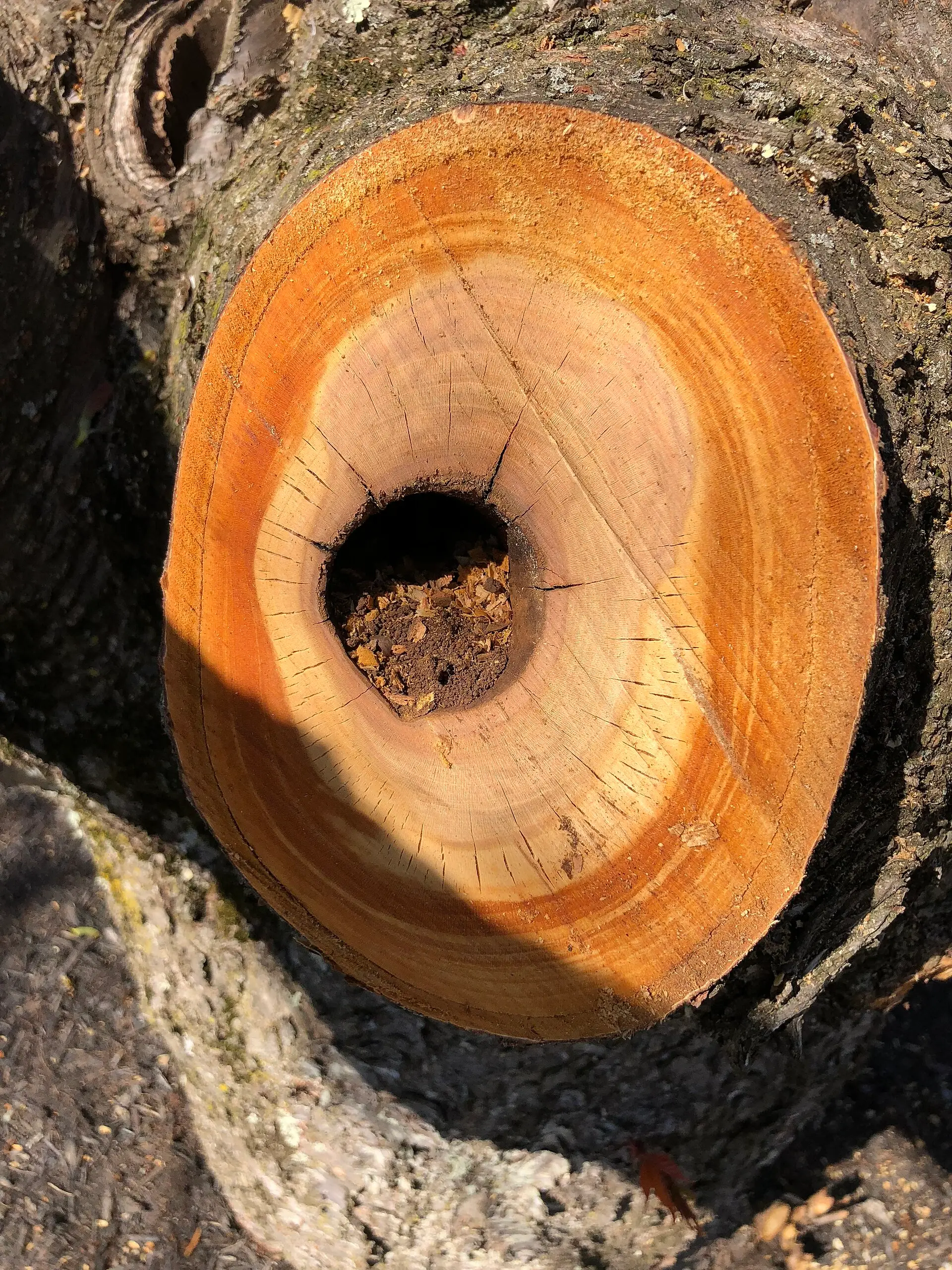
The cherry branch in the photo on this page shows the pattern in miniature: pale sapwood, darker heartwood, and decay. Black cherry heartwood is rated moderately resistant.
Method and limits
We transcribed Table 14-1 from the PDF of chapter 14 of FPL-GTR-282 (2021), and checked each species name against the extracted text column by column. The table is a qualitative grouping, not a test result: it gives no lifespans, does not rank species within a class, and covers heartwood only. It does not include every species sold (red oaks, for example, are absent), and footnote (b) entries group several botanical species. The European EN 350 classes are a different system, based on different tests, and should not be mapped one-to-one onto these classes. Charring and coatings are not covered by this table; see charred wood and treated wood.
Frequently asked questions
Which wood is the most rot resistant?
In the USDA Wood Handbook, the very resistant class includes, among domestic species, black locust, red mulberry, Osage-orange and Pacific yew, and among imported species angelique, azobe, balata, goncalo alves, greenheart, ipe, jarrah, lignumvitae, purpleheart and old-growth teak. The handbook does not rank species within a class, and notes substantial variation within most species.
Is Douglas-fir rot resistant?
Douglas-fir heartwood is in the moderately resistant class of the USDA Wood Handbook, alongside western larch, black cherry, honey locust, tamarack and young-growth redwood. The handbook says species in this class usually require preservative treatment where conditions favor decay. Douglas-fir sapwood, like that of all species, has low resistance.
Why does old-growth wood rate higher than young-growth?
The Wood Handbook notes that old-growth timber is often more decay resistant than second-growth timber of the same species, and that marketable sizes of some species are now mainly second growth with a high proportion of sapwood. This is why Table 14-1 places old-growth redwood and baldcypress in the resistant class but their young growth in the moderately resistant class.
What do EN 350 durability classes mean?
EN 350 is the European standard for natural durability. Its fungal classes run from DC1 (very durable) to DC5 (not durable), and like the USDA table they apply to heartwood only. The two systems use different test methods and are not interchangeable class for class. Our French page lists EN 350 values published by France Bois Forêt for common European species.
Sources
- USDA Forest Service, Forest Products Laboratory (2021). Wood Handbook: Wood as an Engineering Material (FPL-GTR-282), chapter 14: Biodeterioration of Wood (Arango, Lebow, Glaeser)
- USDA Forest Service, Forest Products Laboratory (2021). Wood Handbook (FPL-GTR-282), chapter 15: Wood Preservatives
- USDA Forest Service, Forest Products Laboratory (2021). Wood Handbook (FPL-GTR-282), chapter 16: Finishing Wood
- France Bois Forêt / Fédération Nationale du Bois (2018). Fiche Comprendre C3: la durabilité naturelle des bois
- Oregon State University Extension Service (2026). Using Pressure-Treated Wood for Raised Bed Construction in Oregon (EM 9879)