Charred wood (shou sugi ban) for raised beds: what the decay tests actually show
Charring is not a reliable way to make a raised bed rot-resistant. A 2021 USDA Forest Products Laboratory study of 28 commercial charred products found no systematic improvement in decay resistance; only cypress improved in some tests, and still lost 34% of its mass. Char protects a 1 to 3 mm surface layer at best, and cracks let fungi through.

Key points
- Hasburgh et al. (2021, USDA FPL) tested 28 commercial charred siding products: charring did not systematically improve durability or flammability.
- Only cypress improved, in 3 of 6 combinations, and charred cypress still averaged 34% mass loss in the soil-block test.
- Kymäläinen et al. (2022, Aalto University) found contact charring reduced decay of spruce and birch in a lab test, but fungal hyphae grew through cracks in the char.
- The charred layer is thin: about 1 to 2 mm for flame charring, 2 to 3 mm for yakisugi, so the wood behind it keeps its original durability.
- Charred wood is designed for cladding above ground; the authors of the 2022 study state ground contact is not the intended use.
Charring is a surface treatment, not a durability upgrade
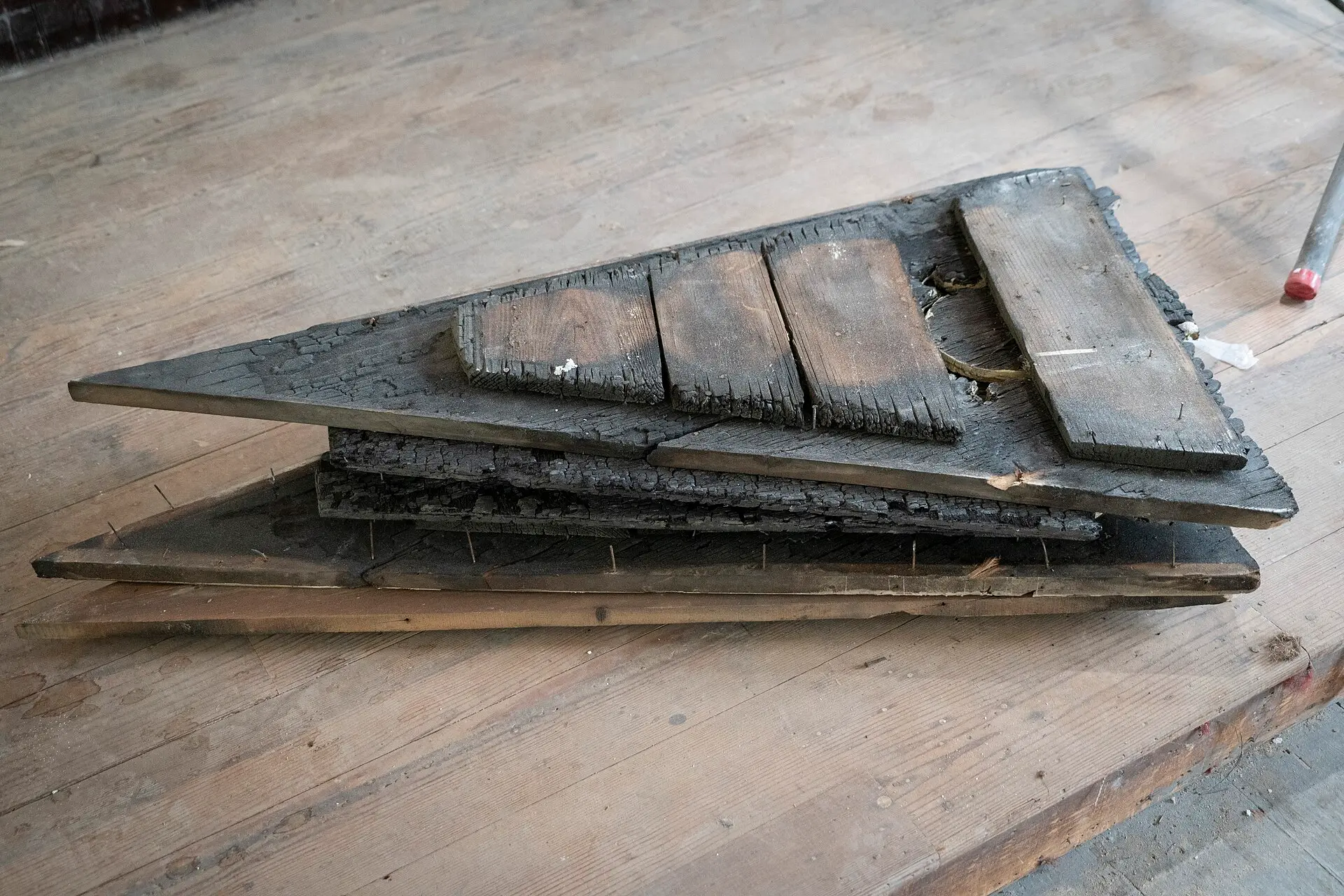
Charred wood, sold as shou sugi ban or yakisugi, is wood whose surface has been burned to a black carbon layer, and the evidence shows that layer does not reliably protect the wood behind it from decay. The technique comes from Japanese exterior cladding, where boards stand vertically above ground, shed water quickly and dry between rains. A raised-bed wall is the opposite case: one face is held against moist soil for months at a time.
Two recent laboratory studies tested charred wood against decay fungi. One, from the USDA Forest Products Laboratory, looked at 28 commercial products. The other, from Aalto University in Finland, compared two charring methods on spruce and birch. Neither found that charring turns a non-durable wood into a durable one, and both explain why.
What the USDA study of 28 charred products found
The most direct test of commercial shou sugi ban is Hasburgh, Zelinka, Bishell and Kirker (2021), published in the journal Forests. The team obtained charred siding in 28 combinations of species, char level (none, light, medium, heavy) and sealer (sealed or unsealed). Species were cypress, hemlock, white oak and black walnut, plus acetylated and furfurylated wood.
They used the AWPA E-10 soil-block test: 19 mm (3/4 in) cubes exposed for 12 weeks to a brown-rot fungus (Gloeophyllum trabeum) and a white-rot fungus (Trametes versicolor), three replicates each. Results:
| Finding | Detail |
|---|---|
| Overall conclusion | Charring “did not systematically improve the flammability or durability” |
| Cypress | 3 of 6 combinations had significantly less decay, 2 no change, 1 more decay |
| Charred cypress mass loss | still averaged 34% |
| Hemlock, white oak, black walnut | little or no improvement |
| Comparison | acetylation, furfurylation, thermal modification and preservatives all outperformed charring |
| Depth of modification | traditional yakisugi changes only the outer 2 to 3 mm (citing Čermák) |
A 34% mass loss after 12 weeks is heavy decay. For scale, in a separate European laboratory test (CEN/TS 15083-1, a different protocol), mature black locust heartwood had a median mass loss of 0.3% with a white-rot fungus, and that standard puts anything under 5% in its top durability class (Pollet et al., 2013). The paper also notes that thermal modification, which is sometimes confused with charring, is a separate industrial process run at 160 to 220 °C (about 320 to 430 °F) in a low-oxygen atmosphere, and treats the whole board rather than its skin.
What the Aalto University study found
Kymäläinen, Belt, Seppäläinen and Rautkari (2022) compared contact charring (pressing wood against a hot plate) with flame charring on spruce and birch sapwood, in Materials. Only the charred face was exposed to fungi, which is a favourable setup for the treatment, and the exposure lasted 9 weeks.
| Wood and treatment | Fungus | Result |
|---|---|---|
| Unmodified birch | both | mass loss up to 60% |
| Unmodified spruce | both | mass loss up to 56% |
| Contact-charred birch | both | mass loss up to 23% |
| Contact-charred spruce | both | mass loss up to 32% |
| Contact-charred spruce | Coniophora puteana (brown rot) | losses cut by 42% |
| Contact-charred birch | Coniophora puteana | losses cut by 70% |
| Contact-charred birch | Trametes versicolor (white rot) | losses cut by 63% |
| Flame-charred birch vs unmodified | both | no significant difference |
Contact charring did slow decay in this test. Flame charring, the method closest to what a gardener would do with a torch, did not show a significant difference on birch. The authors explain why: the flame-charred layer is only about 1 to 2 mm deep, it is porous and absorbs water readily, and it cracks. Fungal biomass was found inside and beneath the char, and the cracks gave hyphae a path into the unprotected wood.
Even the best contact-charred result, 23% mass loss for birch, is far from the performance of durable heartwood. The paper is explicit that charring is meant for cladding, where no ground contact is expected.
Ground contact: why a raised bed is the worst case for char
Raised-bed walls sit in conditions that the decay literature treats as the most severe. The USDA Wood Handbook explains that serious decay occurs only when wood moisture is above fiber saturation (about 30%), and its decay-resistance table carries a footnote warning that resistance may be lower in ground contact and in warm, humid climates. A board held against moist soil can stay above that threshold for most of the growing season.
Char does nothing to the moisture content of the core of the board. Kymäläinen and colleagues note that the porous char absorbs water readily. They also cite older work on Douglas fir fence posts (a 1952 Oregon State report by Graham) in which charring tended to decrease service life in soil contact. We were not able to open that report, so the claim is cited here only as reported in the 2022 paper. Hasburgh’s team notes that charring of fence posts has been studied since at least 1927, and it never became a standard alternative to preservative treatment.
The numbers on thickness make the point concrete. On a 2x board (1.5 in or 38 mm actual), a 3 mm char layer covers 8% of the thickness on one face. The other 92% has whatever natural durability the species had. If the species is pine, spruce or hemlock, which the Wood Handbook rates slightly or nonresistant, a black surface does not change that.
When charred boards can still make sense
Charred boards are not useless in a garden; they are a finish with real but limited properties, and they can be used where those properties fit. Reasonable uses, consistent with the studies:
- On a durable species. If the boards are already a resistant heartwood (see the ratings in our wood durability table), charring the outside face is an aesthetic choice that does not reduce durability in the lab results above.
- Outside face only. The cladding studies tested exposed faces. Charring the face that touches soil gains little and makes the board harder to inspect for rot.
- Above ground. Cap rails, trellis frames and bench tops that stay off the soil are closer to the cladding conditions the technique was designed for.
What charring should not be is a substitute for the species choice. For a bed that has to last, start from a durable heartwood such as black locust, larch or chestnut, or compare the options in which wood is best for raised beds.
Charring versus other ways to extend board life
Several treatments compete with charring for gardeners who want to avoid conventional preservatives, and the FPL study ranks some of them directly. The table summarises what is known.
| Approach | Evidence on decay | Notes |
|---|---|---|
| Durable heartwood (black locust, white oak, cedar heartwood) | Wood Handbook rates these resistant or very resistant | Sapwood of every species is non-durable |
| Charring (shou sugi ban) | No systematic improvement (Hasburgh 2021); thin protective layer (Kymäläinen 2022) | Outer 1 to 3 mm only |
| Thermal modification | Outperformed charring in the 2021 FPL comparison | Industrial process, whole board |
| Acetylation, furfurylation | Outperformed charring in the 2021 FPL comparison | Industrial, sold under brand names |
| Copper-based pressure treatment (MCA, CA) | Outperformed charring in the 2021 FPL comparison | See our page on treated wood in vegetable gardens |
| Oil finishes | No direct decay data in bed use | See food-safe finishes |
Note that the FPL comparison of treatments was against charred siding, in a soil-block test, not in garden beds. It ranks the methods; it does not give service lives in years.
Method and limits
This page is based on two peer-reviewed laboratory studies of charred wood (Hasburgh et al. 2021, open access, USDA Forest Service; Kymäläinen et al. 2022, open access under CC BY) and on the USDA Wood Handbook chapter on biodeterioration. Both studies are short-term lab tests with small samples (three replicates per combination in the FPL study) on cladding products, not field tests in soil. We found no field study of charred boards used as raised-bed walls, no measurement of polycyclic aromatic hydrocarbons or other residues released by charred boards into garden soil, and we could not open the 1952 fence-post report cited by Kymäläinen and colleagues.
Frequently asked questions
Does shou sugi ban make wood rot-proof?
No. In the largest test of commercial products, by the USDA Forest Products Laboratory in 2021, charring did not systematically improve decay resistance across six wood types. Cypress improved in some combinations, but other species showed little or no benefit. The authors concluded that acetylation, furfurylation, thermal modification and preservative treatment all outperform charring.
Is charred wood safe for a vegetable garden?
Charring itself adds no pesticide, which is why it appeals to gardeners. However, no study we found measured what a charred board releases into garden soil, so there is no data either way on combustion residues. The practical problem is durability: the char layer is thin and does not change the decay resistance of the wood behind it.
How deep does charring go?
Only a few millimetres. Kymäläinen and colleagues report a flame-charred layer of about 1 to 2 mm, and Hasburgh and colleagues cite 2 to 3 mm for traditional yakisugi. On a 1.5 inch (38 mm) board, that leaves more than 90% of the thickness unmodified, with the natural durability of the species.
Can I char the bottom of raised bed boards or posts to stop rot?
Charring fence posts has been studied since at least 1927 and has not proved to be a substitute for durable heartwood or treatment. The 2022 Aalto study cites earlier work on Douglas fir fence posts where char tended to decrease service life in soil contact. For posts and bottom boards, a durable species or a gravel base is a safer bet.
Sources
- USDA Forest Service, Forest Products Laboratory (L. Hasburgh, S. Zelinka, A. Bishell, G. Kirker) (2021). Durability and Fire Performance of Charred Wood Siding (Shou Sugi Ban), Forests 12(9):1262
- Aalto University (M. Kymäläinen, T. Belt, H. Seppäläinen, L. Rautkari), MDPI (2022). Decay Resistance of Surface Carbonized Wood, Materials 15(23):8410
- USDA Forest Service, Forest Products Laboratory (2021). Wood Handbook: Wood as an Engineering Material (FPL-GTR-282), chapter 14, Biodeterioration of Wood
- University of Maryland Extension (J. Traunfeld) (2026). Growing vegetables in raised beds
- Forêt Wallonne asbl (C. Pollet, K. Verheyen, J. Hébert, B. Jourez) (2013). Le bois de robinier faux-acacia : propriétés physiques, mécaniques et de durabilité naturelle, Forêt Wallonne n°126