Can you use pallet wood for raised beds? Reading the stamp, and what it does not tell you
Pallet wood can be used for a raised bed if the pallet carries the IPPC mark with the code HT (heat treated) or DH (dielectric heating) and is clean. Avoid pallets marked MB (methyl bromide fumigation), pallets with no mark, and stained or spill-marked pallets. Expect a short life: pallets are usually made of non-durable wood with sapwood.

Key points
- ISPM 15 allows four treatment codes on the mark: HT (56 °C for 30 minutes through the wood), DH, MB and SF; KD is not one of them.
- Kentucky State University advises using HT pallets and avoiding MB pallets, unmarked pallets, stained pallets and colored pallets.
- Methyl bromide was phased out in the US on January 1, 2005 except for quarantine and pre-shipment uses; in the EU it could no longer be used at all after 18 March 2010.
- The mark is a phytosanitary label for international trade: it says nothing about durability, spills or the wood species.
The short answer: use clean HT pallets, avoid MB and unmarked ones
Pallets that cross borders must follow ISPM 15, an international standard from the International Plant Protection Convention (IPPC, hosted by FAO) that requires wood packaging to be treated against pests and marked. The mark tells you which treatment the wood received, which is the main safety question for a vegetable bed. Kentucky State University’s guidance for gardeners sums up the practical rule: look for the IPPC logo, use pallets marked HT, and avoid pallets without the logo, pallets marked MB, pallets with spills or stains, and colored pallets.
The mark answers one question (how was this wood treated against pests) and leaves two open: what the pallet carried afterwards, and how long the wood will last in soil. The rest of this page covers all three.
How to read an ISPM 15 mark, element by element
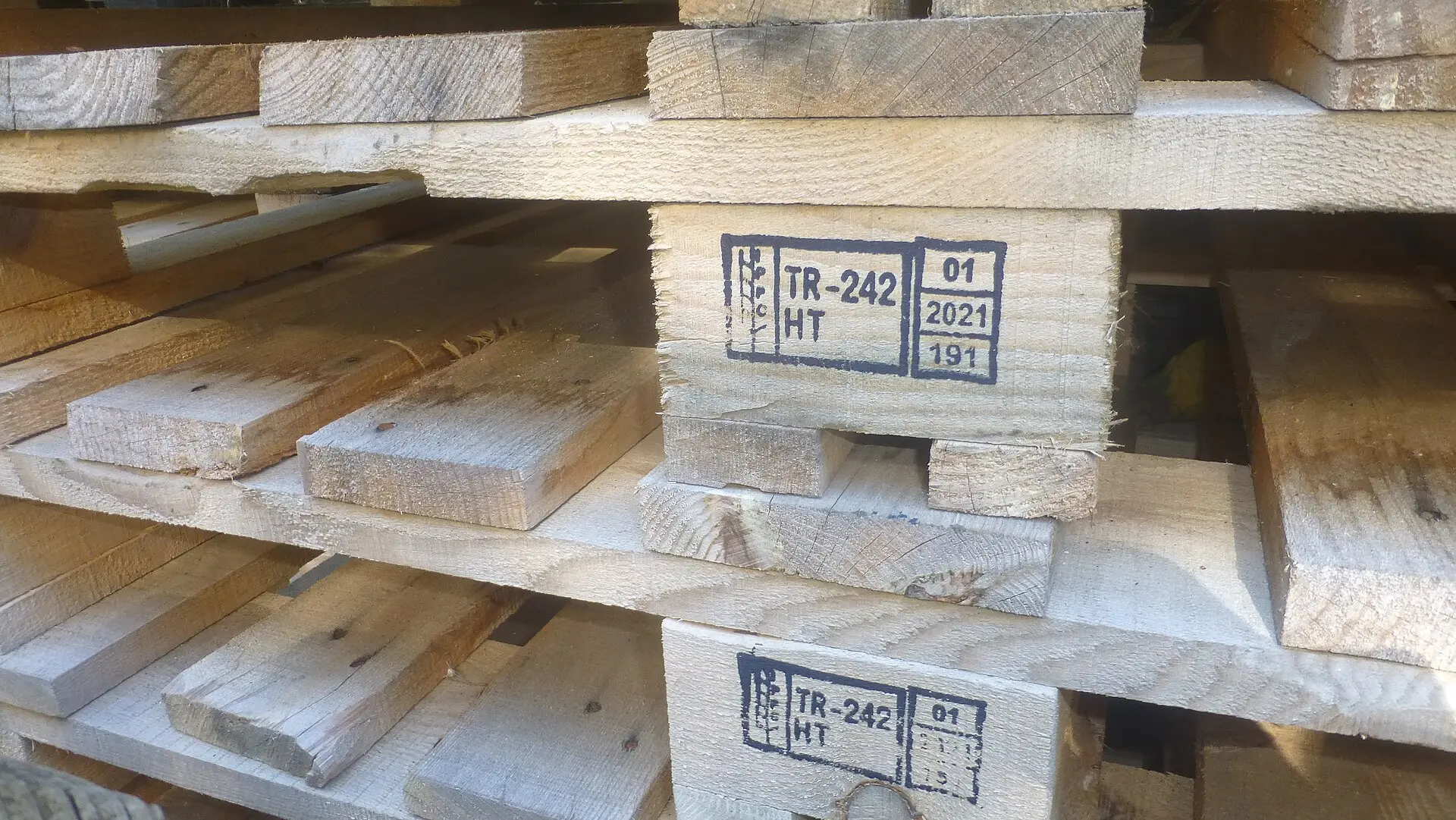
The ISPM 15 mark is a rectangle with a border, the IPPC symbol on the left, and the codes on the right, according to the 2018 text of the standard. It must be legible, durable and not transferable, must not be hand drawn, should avoid red and orange (colors used for dangerous goods labels), and should preferably appear on at least two opposite sides of the unit.
| Element | Example | What it means |
|---|---|---|
| IPPC symbol | Logo to the left of the codes | The wood packaging was treated and marked under ISPM 15 |
| Country code | TR, US, DE, FR | ISO 2-letter code of the country where the treatment was done |
| Producer or treatment provider code | 242 | Number assigned by that country’s plant protection organization, traceable to the company |
| Treatment code | HT | One of HT, DH, MB or SF (see below) |
The image on this page shows a block stamped “TR-242 HT”: treated in Turkey, by provider number 242, by heat treatment. Additional marks such as company logos or pallet-pool brands (EPAL is a common one, cited by Kentucky State) may appear next to it; they are not part of the ISPM 15 mark.
The treatment codes: HT, DH, MB, SF, and the ones that are not codes
ISPM 15 lists exactly four treatment codes that may appear on the mark. The standard’s requirements for each:
| Code | Treatment | ISPM 15 requirement | For a vegetable bed |
|---|---|---|---|
| HT | Heat treatment | At least 56 °C for 30 continuous minutes throughout the profile of the wood, core included | Acceptable: no chemical involved (KSU) |
| DH | Dielectric heating (e.g. microwave) | At least 60 °C for 1 continuous minute throughout the profile | Heat only, no chemical |
| MB | Methyl bromide fumigation | Minimum 24 hours at 10 °C or more; dose expressed as a concentration-time product (650 g·h/m3 at 21 °C or above, 800 g·h/m3 at 16 to 20.9 °C) | Avoid (KSU considers it unsafe for garden use) |
| SF | Sulphuryl fluoride fumigation | Fumigation schedule set in the standard | A fumigant; no garden guidance found |
Two other abbreviations often turn up on pallets:
- DB (debarked). Older versions of the mark used combined codes such as “DB-HT” or “DB-MB” (UK Forestry Commission marking leaflet, 2002). In the current standard, debarking is required for all treated wood whatever the treatment, so DB is no longer a separate code. ISPM 15 asks countries to accept marks made under earlier versions.
- KD (kiln dried). KD is not an ISPM 15 treatment code. The standard notes that kiln-drying can be accepted as heat treatment if it reaches the HT temperature and duration, in which case the mark should say HT.
Debarking tolerances are precise: after treatment, any number of visually separate small pieces of bark may remain if each is less than 3 cm wide, or, if wider, less than 50 cm2 in surface area.
Why methyl bromide pallets are the ones to skip
Methyl bromide is a toxic fumigant and an ozone-depleting substance. The US EPA classifies it as a Class I ozone-depleting substance, notes that it can harm the lungs, eyes and skin, and reports that it was phased out in the United States on January 1, 2005 under the Montreal Protocol, with separate exemptions for quarantine and pre-shipment (QPS) uses and for critical uses. Outside the EU, this exemption is why methyl bromide can still be used for some regulated fumigations.
The European Union went further. Commission Regulation (EU) No 1087/2013 records that the deadline of 18 March 2010 had passed, so methyl bromide can no longer be placed on the market or used in the EU, including for quarantine and pre-shipment. ISPM 15 itself still lists MB but recommends that countries promote alternative treatments, and its environmental section points to obligations under the Montreal Protocol. It also restricts MB to wood with a cross section of 20 cm or less.
An MB pallet you find today could have been fumigated outside the EU, or be old. Kentucky State University classes MB wood as unsafe for use in the garden or as compost bins. With HT pallets widely available, there is no reason to take the risk.
What the mark does not tell you: contamination and species
The ISPM 15 mark certifies a pest treatment at the time of manufacture, for international trade. It does not certify what the pallet carried, where it was stored or whether it was repaired with unmarked wood. The standard requires each new component of a repaired pallet to be marked, but a gardener cannot check every board’s history.
Before using a pallet, check these points, following Kentucky State’s guidance:
- The IPPC mark is present and legible, with HT or DH. No mark: skip it, because its treatment is unknown.
- No spills, stains or unusual odors. A pallet that carried chemicals can be contaminated whatever its treatment code.
- Not painted or colored. Kentucky State advises avoiding colored pallets.
- Prefer pallets used for dry goods, if you know their history.
ISPM 15 also exempts some materials from treatment: wood 6 mm thick or less, processed wood products such as plywood, particleboard and oriented strand board, wine and spirit barrels heated during manufacture, and sawdust, wood shavings and wood wool. Pallets built entirely from such materials may carry no mark at all, which does not mean they are untreated wood.
How long will pallet boards last in a raised bed?
Pallet boards are a poor match for soil contact, for reasons that come from the USDA Wood Handbook rather than from pallets as such. Pallets are built from whatever wood is cheap where they are made, the species is not marked, and the boards often include sapwood. The handbook states that untreated sapwood of essentially all species has low resistance to decay, and that most common construction softwoods (spruces, true firs, hemlocks, most pines) are slightly or nonresistant even in their heartwood. Heat treatment kills pests but adds no protection against decay.
Pallet boards are also thin. A thin board in contact with wet soil rots through sooner than a thick one, and bows under soil pressure (see raised bed board thickness). We found no study giving a lifespan in years for a pallet raised bed, so we do not quote one.
Ways to get more out of pallet wood:
- Use it where soil contact is limited: a vertical planter, a compost bin, or the upper courses of a bed whose bottom board is a durable species.
- Use the heaviest boards and the blocks (stringers) for the parts that touch soil.
- Treat it as temporary, and plan the bed so boards can be swapped.
If you want a bed that lasts, compare species in the best wood for raised beds and check the data in the wood durability table. If you want to protect the outside face, see finishes for raised bed wood. To count how many boards you need, use the lumber calculator.
Method and limits
The mark anatomy, treatment codes, schedules, exemptions and debarking tolerances come from the 2018 revision of ISPM 15 (published 2019 by FAO for the IPPC). The DB code history comes from a 2002 UK Forestry Commission leaflet hosted by the IPPC. Safety advice for gardeners comes from Kentucky State University; we did not find a peer-reviewed study measuring residues in soil or plants from HT or MB pallet wood. National rules for implementing ISPM 15 vary, and the standard covers wood packaging in international trade, so pallets that never leave one country may carry no mark.
Frequently asked questions
Are HT pallets safe for vegetable gardens?
HT means the wood was heated so that its core reached 56 °C for 30 continuous minutes, a treatment with no chemical. Kentucky State University describes HT pallets as otherwise untreated and safe to use. The mark does not cover what the pallet carried afterwards, so reject pallets with spills, stains or strong odors, and remember that pallet wood is usually not decay resistant.
What does MB mean on a pallet?
MB means the wood was fumigated with methyl bromide, an ozone-depleting pesticide. ISPM 15 still lists it as an approved treatment but encourages countries to promote alternatives. Kentucky State University considers MB pallets unsafe for garden use. Methyl bromide was phased out in the US in 2005 except for quarantine and pre-shipment uses, and banned in the EU in 2010.
What does KD mean on a pallet?
KD stands for kiln dried, a moisture treatment. It is not one of the four treatment codes in ISPM 15 (HT, DH, MB, SF), so a KD mark alone is not an ISPM 15 phytosanitary mark. The standard does say that kiln-drying can count as heat treatment if it meets the HT temperature and time, in which case the pallet should be marked HT.
How long will a pallet raised bed last?
No study we found gives a lifespan for pallet beds. The USDA Wood Handbook says untreated sapwood of essentially all species has low decay resistance, and HT pallets are untreated wood of whatever species was available. In soil contact, expect pallet boards to rot faster than heartwood of a durable species such as cedar or black locust.
Sources
- FAO, International Plant Protection Convention (2019). ISPM 15: Regulation of wood packaging material in international trade (2018 revision)
- Kentucky State University, College of Agriculture (2019). What Wood is Safe to Use in My Garden?
- US Environmental Protection Agency (2026). Methyl Bromide
- European Commission (2013). Commission Regulation (EU) No 1087/2013 amending Regulation (EC) No 1005/2009 as regards methyl bromide
- Forestry Commission (hosted by IPPC) (2002). Plant Health Leaflet No 12: UK wood packaging marking programme
- USDA Forest Service, Forest Products Laboratory (2021). Wood Handbook (FPL-GTR-282), chapter 14: Biodeterioration of Wood