How deep should a raised bed be? Root depth by vegetable, and the difference between beds on soil and on concrete
On open ground, a raised bed 8 to 12 inches (20 to 30 cm) deep is enough if the soil beneath is loosened another 6 to 12 inches, because roots keep growing downward. On concrete or paving the bed holds all the roots: University of Maryland Extension gives 8 inches minimum for greens, beans and cucumbers and 12 to 24 inches for tomatoes, peppers and squash.
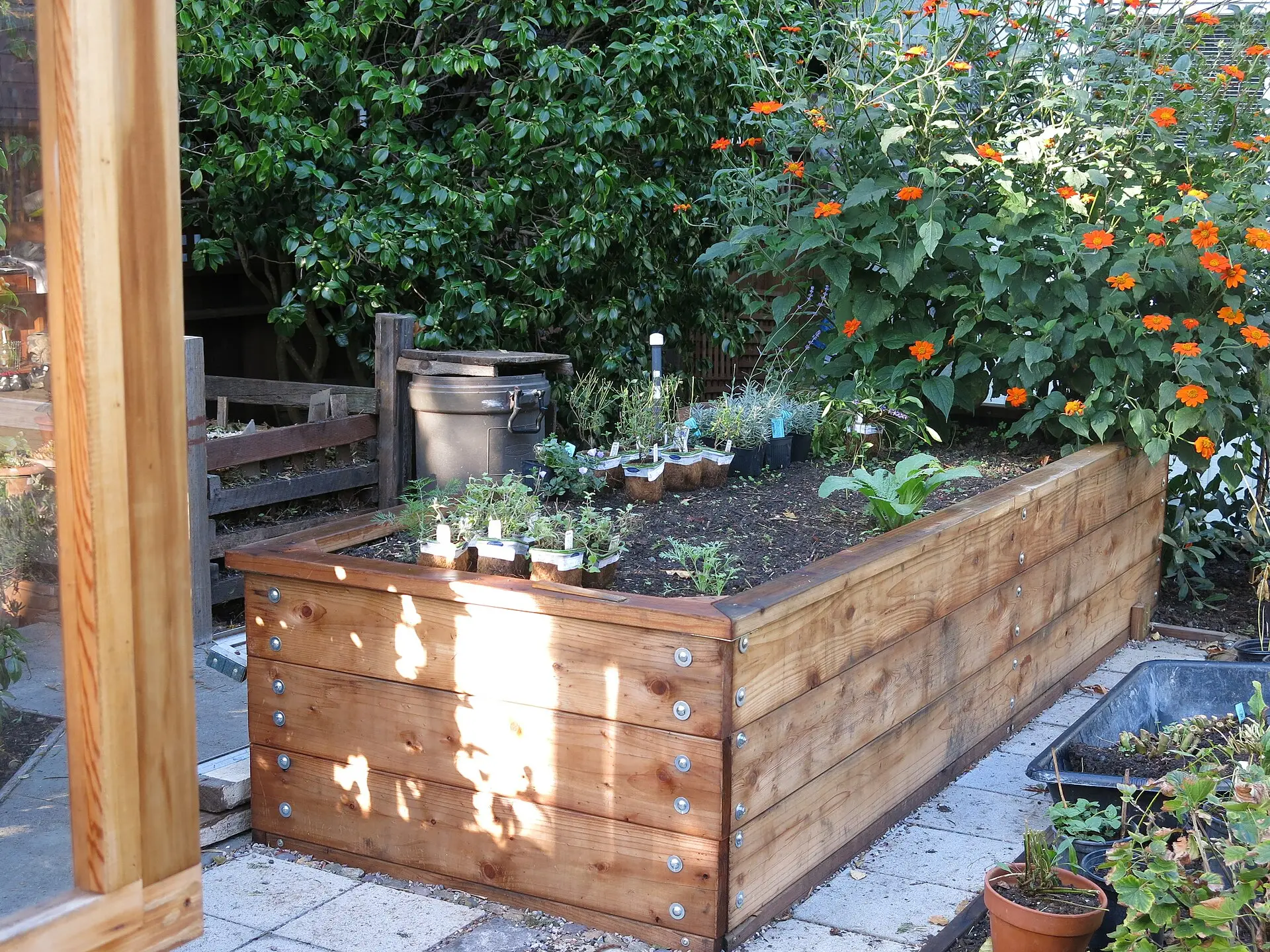

Key points
- University of California data class vegetables as shallow-rooted (12-18 in), moderately deep (18-24 in) or deep-rooted (more than 24 in).
- On native soil, extension services recommend beds 6 to 12 in high with the ground below loosened 6 to 12 in (Utah State, Oregon State).
- On hard surfaces, Maryland sets 8 in as the minimum for leafy greens, beans and cucumbers, and 12 to 24 in for peppers, tomatoes and squash.
- The RHS considers 30 cm (12 in) enough for salads and strawberries and 45 cm (18 in) or more for most plants.
- Every extra inch on a 4x8 ft bed adds 2.67 cu ft (76 L) of soil, and Oregon State advises reinforcing beds taller than about 18 in.
The short answer: depth depends on what is underneath
How deep a raised bed needs to be depends first on whether roots can continue into the ground below it. On open soil, the bed is only the top part of the root zone: loosen the ground underneath and roots carry on downward. On concrete, paving or a roof, the bed is the entire root zone, and it must be as deep as the crops need.
| Situation | Recommended bed depth | Source |
|---|---|---|
| Unframed bed or mound on soil | 4 to 8 in (10 to 20 cm) | Clemson HGIC 1257 |
| Unframed bed on soil | About 8 in (20 cm) | Oregon State FS 270 |
| Framed bed on loosened soil | 6 to 12 in (15 to 30 cm), with the ground beneath loosened 6 to 12 in | Utah State |
| Framed bed on soil | Dig or rototill at least 6 in (15 cm) beneath | Oregon State FS 270 |
| Framed bed, general | 8 to 12 in (20 to 30 cm) usually adequate; 12 to 18 in (30 to 45 cm) for vegetables | Texas A&M E-560 |
| Hard surface: leafy greens, beans, cucumbers | At least 8 in (20 cm) | Univ. of Maryland |
| Hard surface: peppers, tomatoes, squash | 12 to 24 in (30 to 60 cm) | Univ. of Maryland |
| Salads, strawberries, dwarf bulbs | 30 cm (12 in) | RHS |
| Most plants | 45 cm (18 in) or more | RHS |
Utah State adds a rule of thumb: beds shallower than 12 in (30 cm) should be bottomless, so the roots can reach the native soil. If you build on paving, see raised beds on concrete for drainage and base details.
How deep vegetable roots grow: crop-by-crop data
University of California Cooperative Extension groups vegetables by rooting depth, using data from Knott’s Handbook for Vegetable Growers (Lorenz and Maynard). These depths describe roots growing in open ground, not a target fill depth; in a bottomless bed, part of this depth is in the loosened soil below.
| Rooting group | Typical rooting depth | Vegetables |
|---|---|---|
| Shallow | 12 to 18 in (30 to 45 cm) | Broccoli, Brussels sprouts, cabbage, cauliflower, celery, Chinese cabbage, collards, corn, endive, garlic, leek, lettuce, onion, parsley, potato, radish, spinach, strawberry |
| Moderately deep | 18 to 24 in (45 to 60 cm) | Bush and pole beans, beet, cantaloupe, carrot, chard, cucumber, eggplant, kale, mustard, peas, peppers, summer squash, turnip |
| Deep | More than 24 in (60 cm) | Artichoke, asparagus, lima bean, okra, parsnip, pumpkin, rhubarb, sweet potato, tomato, watermelon, winter squash |
Two things stand out. Many of the most common raised-bed crops (lettuce, spinach, onions, garlic, radish) are in the shallow group. And the deep group includes the heavy feeders that people most often want to grow, tomatoes and winter squash, which is why Maryland sets 12 to 24 in for them on a hard surface.
Note that Maryland’s hard-surface figures are lower than the UC rooting depths. Rooting depth is how far roots can go in open ground, not the minimum they need; a container-style bed with regular watering and feeding can support crops in less soil than their natural root spread, at the cost of more frequent irrigation.
Beds on soil: count the loosened ground as part of the root zone
On open ground, effective rooting depth is the bed height plus the depth of loosened soil beneath it. Oregon State recommends digging or rototilling at least 6 in (15 cm) beneath a framed bed; Utah State recommends 6 to 12 in (15 to 30 cm). A simple calculation shows why that matters:
- 8 in bed + 8 in of loosened ground = 16 in (40 cm) of workable rooting depth, enough for the whole shallow group.
- 12 in bed + 12 in loosened = 24 in (60 cm), which reaches the moderately deep group.
Loosening is cheaper than soil. The native ground also buffers moisture: a bottomless bed connected to the subsoil dries out more slowly than the same bed on concrete. If the native soil is contaminated, though, roots should not reach it; that case calls for a barrier and a deeper bed (see the hard-surface figures).
Beds on hard surfaces: the bed is the whole root zone
On concrete, paving, decking or a rooftop, all water and nutrients come from the bed itself, so depth is a direct limit on what will grow. Maryland’s guidance is the most specific published set: 8 in (20 cm) minimum for leafy greens, beans and cucumbers, 12 to 24 in (30 to 60 cm) for peppers, tomatoes and squash. It also recommends a fill of compost and soilless mix 1:1 for these beds, with up to 20% topsoil when the bed is at least 16 in (40 cm) deep; the full mix discussion is in raised bed soil mix.
The RHS lines up with this: 30 cm (12 in) for salads, strawberries and dwarf bulbs, 45 cm (18 in) or more for most plants. For beds deeper than 50 cm (20 in), the RHS suggests putting rubble or subsoil in the bottom rather than filling the whole depth with topsoil.
A wicking bed is a special case: water rises only about 12 in (30 cm) by capillarity, so a deeper soil layer does not help. See how to build a wicking bed.
What depth costs: soil volume and board courses
Each extra inch of depth adds soil, weight and load on the boards. For a 4x8 ft bed (32 sq ft, 2.97 m2), volume rises by 32 / 12 = 2.67 cu ft (about 76 L) per inch:
| Fill depth | Volume (cu ft) | Cubic yards | Metric | Typical frame (actual board width) |
|---|---|---|---|---|
| 6 in (15 cm) | 16 | 0.59 | 0.45 m3 | One 2x6 (5.5 in, 140 mm) |
| 8 in (20 cm) | 21.3 | 0.79 | 0.60 m3 | One 2x8 (7.25 in, 184 mm) plus a little mounding |
| 12 in (30 cm) | 32 | 1.19 | 0.91 m3 | Two 2x6 (11 in, 279 mm) or one 2x12 (11.25 in, 286 mm) |
| 18 in (45 cm) | 48 | 1.78 | 1.36 m3 | Two 2x10 (18.5 in, 470 mm) |
| 24 in (60 cm) | 64 | 2.37 | 1.81 m3 | Three 2x8 (21.75 in, 552 mm) or two 2x12 (22.5 in, 572 mm) |
Volumes are length x width x depth (4 x 8 x depth in feet); cubic yards = cu ft / 27; m3 = cu ft x 0.02832. Real fill is usually a little below the board height, since the RHS advises filling to about 5 cm (2 in) under the rim and topping up after settling. For other shapes, use the raised bed soil calculator.
Taller beds also push harder on the frame. Oregon State advises reinforcing beds taller than about 18 in (45 cm) or longer than 6 ft (1.8 m), for example with cross-ties or mid-span stakes, and limiting width to 4 ft (1.2 m) so the centre can be reached from both sides. If the goal is to reduce bending rather than to give roots more room, see accessible raised bed height: a tall bed can be partly filled with coarser material at the bottom.
Choosing your depth: a decision sequence
Work through these questions in order:
- What is under the bed? Soil you can loosen: 8 to 12 in of bed is enough for most crops. Hard surface or contaminated ground: go to step 3.
- What will you grow on soil? Shallow and moderately deep crops: 8 to 12 in, plus 6 to 12 in of loosened ground. Deep-rooted crops such as tomatoes and winter squash: 12 in or more, with the ground loosened deeply.
- On a hard surface: 8 in minimum for greens, beans and cucumbers; 12 to 24 in for tomatoes, peppers and squash; 18 in or more as a general-purpose depth (RHS).
- Check structure and budget: above about 18 in, reinforce the frame (Oregon State) and price the soil using the table above.
Method and limits
The crop rooting groups come from University of California Cooperative Extension, which summarizes Knott’s Handbook; they describe roots in open field soil and are general categories, not measurements in raised beds. Bed depth recommendations come from five US extension services and the RHS, which agree in broad terms but are guidance rather than trial results. We did not find a controlled study comparing yields at different raised-bed depths for common vegetables, except for wicking beds, where 12 in of soil outperformed 24 in in one tomato trial.
Frequently asked questions
Is 12 inches deep enough for a raised bed?
Yes, for most vegetables when the bed sits on soil that has been loosened underneath, since roots continue into the ground. Texas A&M says 8 to 12 inches is usually adequate, and Utah State recommends that beds under 12 inches be bottomless. On concrete, 12 inches suits salads and strawberries per the RHS but is the minimum for tomatoes.
How deep should a raised bed be for tomatoes?
Tomatoes are classed as deep-rooted, with roots beyond 24 inches in open ground, in University of California vegetable data. On a hard surface, University of Maryland Extension recommends 12 to 24 inches of soil for tomatoes, peppers and squash. On loosened native soil, a 12-inch bed lets roots continue into the ground below.
How deep should a raised bed be on concrete?
Deeper than on soil, because the bed is the whole root zone. University of Maryland Extension sets a minimum of 8 inches for leafy greens, beans and cucumbers and 12 to 24 inches for peppers, tomatoes and squash. The RHS says 45 cm (18 in) or more suits most plants. Drainage holes or gaps at the base remain necessary.
How deep do carrot and root crop beds need to be?
University of California data place carrots, beets and turnips in the moderately deep group (18 to 24 inches) and parsnips in the deep group (over 24 inches). Radishes and onions are shallow-rooted (12 to 18 inches). On loosened soil a 12-inch bed works; on a hard surface aim for 18 inches or more for long carrots.
Sources
- University of California Cooperative Extension, Placer and Nevada Counties (C. Fake), after Knott's Handbook for Vegetable Growers (2011). Vegetable Characteristics (Publication 31-043C-11)
- University of Maryland Extension (J. Traunfeld, reviewed by N. Little) (2024). Soil to Fill Raised Beds
- Oregon State University Extension Service (B. Edmunds) (2020). Raised Bed Gardening (FS 270)
- Utah State University Extension (K. Heflebower et al.) (2012). Raised Bed Gardening
- Texas A&M AgriLife Extension (P. Files, M. Arnold, D. Welsh, F. Dainello) (2009). Raised Bed Gardening (E-560)
- Royal Horticultural Society (2025). How to make a raised bed
- Clemson Cooperative Extension, Home & Garden Information Center (2017). Raised Beds (HGIC 1257)