Raised bed plant spacing: how many plants per square foot, crop by crop
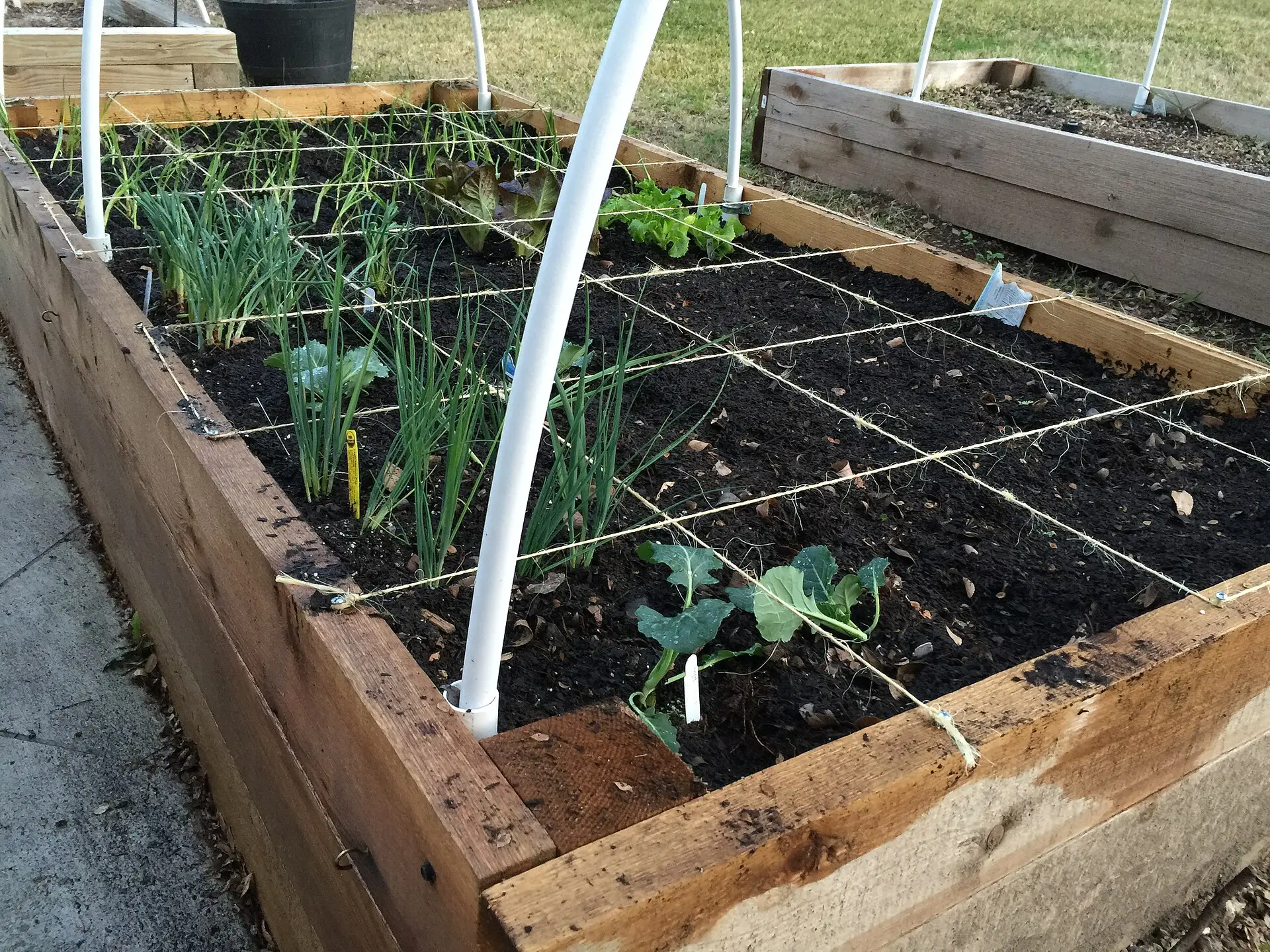
In a raised bed, space plants equally in both directions instead of in rows. The square foot method uses 1, 4, 9 or 16 plants per square foot (12, 6, 4 or 3 inch spacing). Colorado State's block spacings differ by crop: leaf lettuce 7 to 9 inches, spinach 4 to 6, carrots 2 to 3. Start wide and tighten as the soil improves.

Key points
- Plants per square foot = (12 / spacing in inches)^2; plants per m2 = (100 / spacing in cm)^2.
- Square foot gardening: 16 per sq ft for carrots and radishes, 9 for spinach and bush beans, 4 for lettuce, 1 for tomato, pepper or broccoli.
- Colorado State recommends equal spacing in both directions, beds 3 to 4 ft wide, paths 18 to 24 in, and starting at the wider spacing.
- An offset (triangular) layout fits about 15 percent more plants than a square grid at the same distance between neighbours.
- A French trial on corn salad found yield rose with density up to 32 plants/m2 on standard mulch film; a 15 x 15 cm grid (44/m2) gave 30 to 45 percent more than 28/m2.
How spacing works in a raised bed
Plant spacing in a raised bed is set by the distance between neighbouring plants in every direction, not by row spacing, because nobody walks between the plants. Colorado State University Extension (GardenNotes #713) puts it simply: “Plant crops with an equal distance of space between neighboring plants in both directions.” A carrot patch, in their example, is spaced on 3 x 3 inch centres.
Two layout rules come with it, from the same publication:
- Beds 3 to 4 ft (0.9 to 1.2 m) wide, any length, so the centre can be reached from the path. Washington State University’s Skagit County Master Gardeners add that 3 ft is actually better than 4 for reach.
- Walkways 18 to 24 in (45 to 60 cm) wide, with foot traffic limited to them to avoid compacting the bed.
Colorado State claims block layouts can increase yields fivefold compared with a traditional row garden, and fifteen-fold for small kitchen-garden vegetables. Those figures compare whole-garden area including the paths that row gardens need; they are not a promise that every crop yields more per plant.
The formula: from spacing to plants per square foot
Any spacing figure converts to a density with one line of arithmetic, which is how every chart on this page was built.
- Square grid, spacing s in inches: plants per square foot = (12 / s)^2. At 6 in: (12 / 6)^2 = 4.
- Metric, spacing s in cm: plants per square metre = (100 / s)^2. At 15 cm: (100 / 15)^2 = 44.
- Offset (triangular) grid: each plant sits in the gap of the row before. The rows are closer together (s x 0.866), so density rises to 1.155 / s^2, about 15.5 percent more plants at the same distance between neighbours. At 6 in: 4 x 1.155 = 4.6 plants per square foot.
One square foot is 0.0929 m2, so 1 plant per square foot equals 10.8 plants per m2. The offset layout is pure geometry: it keeps every plant the same distance from its neighbours, so it suits leafy crops planted at fixed spacing (lettuce, chard, onions). It gains little for crops sown in a dense band and thinned, such as carrots.
Spacing chart for kitchen-garden crops (Colorado State block spacing)
Colorado State’s GardenNotes #713 gives equidistant spacings for small kitchen-garden vegetables and advises: “Start with the wider spacings, reducing spacing with experience and as soil improves fertility and tilth.” The density columns are our conversion with the formula above.
| Crop | CSU spacing (in) | Metric (cm) | Plants per sq ft | Plants per m2 |
|---|---|---|---|---|
| Carrots | 2-3 x 2-3 | 5-7.5 | 16 to 36 | 172 to 387 |
| Radishes | 2-3 x 2-3 | 5-7.5 | 16 to 36 | 172 to 387 |
| Bunching onions | 2-3 x 2-3 | 5-7.5 | 16 to 36 | 172 to 387 |
| Beets | 4-6 x 4-6 | 10-15 | 4 to 9 | 43 to 97 |
| Garlic | 4-6 x 4-6 | 10-15 | 4 to 9 | 43 to 97 |
| Leeks | 4-6 x 4-6 | 10-15 | 4 to 9 | 43 to 97 |
| Dry onions | 4-6 x 4-6 | 10-15 | 4 to 9 | 43 to 97 |
| Spinach | 4-6 x 4-6 | 10-15 | 4 to 9 | 43 to 97 |
| Turnips | 4-6 x 4-6 | 10-15 | 4 to 9 | 43 to 97 |
| Parsnips | 5-6 x 5-6 | 12.5-15 | 4 to 5.8 | 43 to 62 |
| Leaf lettuce | 7-9 x 7-9 | 18-23 | 1.8 to 2.9 | 19 to 32 |
| Swiss chard | 7-9 x 7-9 | 18-23 | 1.8 to 2.9 | 19 to 32 |
| Kohlrabi | 7-9 x 7-9 | 18-23 | 1.8 to 2.9 | 19 to 32 |
| Celery | 7-9 x 7-9 | 18-23 | 1.8 to 2.9 | 19 to 32 |
| Head lettuce | 10-12 x 10-12 | 25-30 | 1 to 1.4 | 11 to 15 |
Larger crops: Colorado State’s raised-bed planting guide
Large fruiting and cole crops are usually planted in short rows across a 4 ft bed rather than on a tight grid. Colorado State’s GardenNotes #721 (2024) gives these spacings for a bed 4 ft wide with rows running across it. The density column is our calculation from the row geometry.
| Crop | CSU #721 spacing | Approx. plants per sq ft |
|---|---|---|
| Broccoli, cabbage, cauliflower | 3 plants across a 4 ft row, rows 18 in apart | 0.5 (3 plants per 6 sq ft) |
| Peppers | 3 plants across a 4 ft row, rows 18 in apart | 0.5 |
| Eggplant | 3 plants across a 4 ft row, rows 18 to 24 in apart | 0.4 to 0.5 |
| Potatoes | 3 to 4 plants across a 4 ft row, rows 15 in apart | 0.6 to 0.8 |
| Tomatoes | 24 in apart, single trellised row | see note |
| Cucumbers | 6 in apart, single trellised row | see note |
| Sweet corn | 9 in between plants, block of at least 4 rows | 1.8 (at 9 x 9 in) |
| Pole and bush beans | thinned to 4 in (single or double row) | see note |
| Peas | thinned to 3 to 4 in, rows 8 in or more apart | about 4.5 to 6 |
Trellised crops do not translate cleanly into plants per square foot, because their footprint depends on how wide a strip you leave beside the trellis. Corn must be planted in a block of at least four rows for pollination, according to the same guide.
The square foot gardening rule of 1, 4, 9 and 16
Square foot gardening (SFG), popularised by Mel Bartholomew in 1981, divides the bed into 1 ft squares and puts 1, 4, 9 or 16 plants in each, which are simply 12, 6, 4 and 3 inch square grids. UC Cooperative Extension Master Gardeners of Tulare-Kings Counties explain it from the seed packet: if the packet says “thin to” 12 inches, plant 1 per square; 6 inches, 4; 4 inches, 9; 3 inches, 16. Their chart groups crops like this:
| SFG size class | Plants per square | Spacing | Examples (UCCE Tulare-Kings chart) |
|---|---|---|---|
| XL | 1 per 2 squares | about 17 in | Watermelon, zucchini, pumpkin, melon, winter and summer squash |
| L | 1 | 12 in (30 cm) | Tomato, eggplant, broccoli, cabbage, cauliflower, cucumber, okra, pepper |
| M | 4 | 6 in (15 cm) | Lettuce, basil, marigold, corn, parsley, potato, strawberry, turnip |
| S | 9 | 4 in (10 cm) | Bush bean, beet, spinach |
| XS | 16 | 3 in (7.5 cm) | Radish, carrot, onions |
Charts disagree at the edges. The WSU Skagit article, citing the Square Foot Gardening Foundation, puts kale, potatoes and strawberries at 4 per square, bush beans and large beets at 9, and small beets at 16. The UC chart lists cucumber at 1 per square, while Colorado State spaces trellised cucumbers 6 in apart in a single row. These are rules of thumb built around a 6 to 8 in deep (15 to 20 cm) mix of one-third compost, one-third peat moss and one-third vermiculite, as both the WSU and UC documents describe, not trial-derived optima.
SFG and Colorado State side by side
Comparing the two systems on the same crops shows where the square foot grid is tighter than extension guidance:
| Crop | SFG (UCCE chart) | Colorado State | Comment |
|---|---|---|---|
| Lettuce | 4 per sq ft (6 in) | Leaf 7-9 in (1.8-2.9), head 10-12 in (1-1.4) | SFG is tighter; fine for cut leaves, tight for heads |
| Spinach | 9 per sq ft (4 in) | 4-6 in (4-9) | SFG is at the dense end of CSU’s range |
| Carrots | 16 per sq ft (3 in) | 2-3 in (16-36) | SFG is at the wide end of CSU’s range |
| Broccoli, cabbage | 1 per sq ft | about 0.5 per sq ft | SFG is twice as dense |
| Tomato | 1 per sq ft | 24 in in a trellised row | SFG assumes strict staking and pruning |
Worked example: planning a 4x8 ft bed
A 4x8 ft (1.2 x 2.4 m) bed has 32 sq ft (2.9 m2). Counting plants is easiest by positions: along a side of length L with spacing s, plants sit s/2 from the edge, so the count is L / s rounded down.
- Tomatoes along the north end, trellised at 24 in (CSU): 48 / 24 = 2 plants across the 4 ft end, using a strip about 1.5 ft deep (6 sq ft).
- Peppers, one row of 3 across the bed (CSU), 18 in strip: 3 plants, 6 sq ft.
- Leaf lettuce at 8 in on a square grid in a 4 x 2 ft block: 48 / 8 = 6 by 24 / 8 = 3, so 18 plants in 8 sq ft. An offset grid in the same block fits only 6 + 5 + 6 = 17 plants, because the block is narrow; the 15 percent gain appears in larger blocks.
- Carrots at 3 x 3 in in a 4 x 1.5 ft strip: 16 x 6 = 96 carrots in 6 sq ft.
- Spinach at 5 in in the remaining 4 x 1.5 ft: 48 / 5 = 9 by 18 / 5 = 3, so 27 plants in 6 sq ft.
Total: the full 32 sq ft, with 146 plants; as each block is harvested it can be resown. Bed size and cut list are covered in how to build a 4x8 raised bed; the soil volume for this layout is in our raised bed soil mix guide.
What the evidence says about crowding
Closer spacing raises yield per square foot only up to a point, and that point depends on the crop. The best open data on this comes from market-gardening trials rather than home beds. In trials reported by GRAB (the French organic research group in Avignon) on corn salad (mache) under cold tunnels in 2006 and 2007, yield increased with density up to 32 plants/m2 on standard lettuce-type mulch film, and not beyond. A 2008 trial with a square 15 x 15 cm layout (44 plants/m2, about 4 per square foot) developed normally without disease problems and yielded 30 and 45 percent more, in two production slots, than 28 plants/m2.
That trial supports two practical conclusions for raised beds: a square, equidistant grid can carry more plants than row-based mulch layouts, and there is a ceiling beyond which more plants add work and seed cost without more harvest. Tight spacing also raises demand for water and nutrients per square foot, so a densely planted bed needs a deep enough root zone (see how deep a raised bed should be) and a reliable watering setup such as drip irrigation.
Method and limits
The spacing ranges on this page come from Colorado State University Extension (GardenNotes #713 and #721), UC Cooperative Extension and WSU Extension Master Gardener publications on square foot gardening, and one French trial report from GRAB. Plants-per-area figures are our conversions using the formulas shown. Extension spacings are guidance from experienced educators rather than controlled yield trials, and square foot gardening charts are a teaching system with promotional claims (for example 20 percent of the space for 100 percent of the harvest on the UC handout) that we have not seen tested. Variety, climate, season and soil fertility change the right spacing; use the wider end until your own bed shows it can carry more.
Frequently asked questions
How many plants can I fit in a 4x8 raised bed?
A 4x8 bed has 32 square feet. Under square foot gardening that is 32 tomatoes or peppers at 1 per square, 128 lettuces at 4, 288 spinach at 9 or 512 carrots at 16. Real beds mix crops: Colorado State's raised-bed guide puts 3 peppers or 3 broccoli across a 4 ft row with rows 18 inches apart, about one plant per 2 square feet.
How far apart should tomatoes be in a raised bed?
Colorado State's raised-bed planting guide spaces tomatoes 24 inches apart in a single trellised row. Square foot gardening charts allow one tomato per square foot, which only works for plants that are staked or trellised and pruned. For sprawling or caged indeterminate plants, the wider spacing is the safer starting point.
What is the square foot gardening spacing rule?
Each square foot holds 1, 4, 9 or 16 plants, matching 12, 6, 4 or 3 inch spacing. UC Cooperative Extension Master Gardeners explain it from the seed packet: if the packet says thin to 12 inches, plant 1 per square; 6 inches, 4; 4 inches, 9; 3 inches, 16. Very large crops such as squash or melon get 1 plant per 2 squares.
Is closer spacing always more productive?
No. Colorado State advises starting with the wider spacing and tightening only as fertility and soil tilth improve. In a French trial on corn salad under cold tunnels, yield rose with density up to 32 plants per square metre on standard mulch film and not beyond, although a 15 x 15 cm grid outperformed the lower density.
Sources
- Colorado State University Extension (D. Whiting, C. O'Meara, C. Wilson) (2023). Block Style Layout in Raised Bed Vegetable Gardens, GardenNotes #713
- Colorado State University Extension (D. Whiting, C. O'Meara, C. Wilson) (2024). Sample Planting Guide for Raised-Bed Garden, GardenNotes #721
- University of California Cooperative Extension Master Gardeners of Tulare-Kings Counties (2021). How To: Square Foot Garden
- Washington State University Extension, Skagit County Master Gardeners (H. Custer) (2016). Square Foot Gardening: Simple, Versatile and Fun!
- GRAB / Chambre régionale d'agriculture PACA, REFBIO maraîchage (C. Mazollier) (2009). La mâche en agriculture biologique : itinéraire de production sous tunnel froid en région PACA
- Square Foot Gardening Foundation (2024). Plant spacing for a typical 4' x 4' Square Foot Garden