Screws for raised beds: how wet soil, tannins and copper-treated wood corrode fasteners, and what to use
Use type 304 (A2) stainless-steel screws for a raised bed, or 316 (A4) near the sea or road salt. Bed walls stay wet, and wet wood corrodes steel: copper-treated lumber and tannin-rich woods such as oak and cedar speed it up. Hot-dip galvanized fasteners meet the US code for treated wood, but zinc corroded faster than plain steel in Forest Service tests.
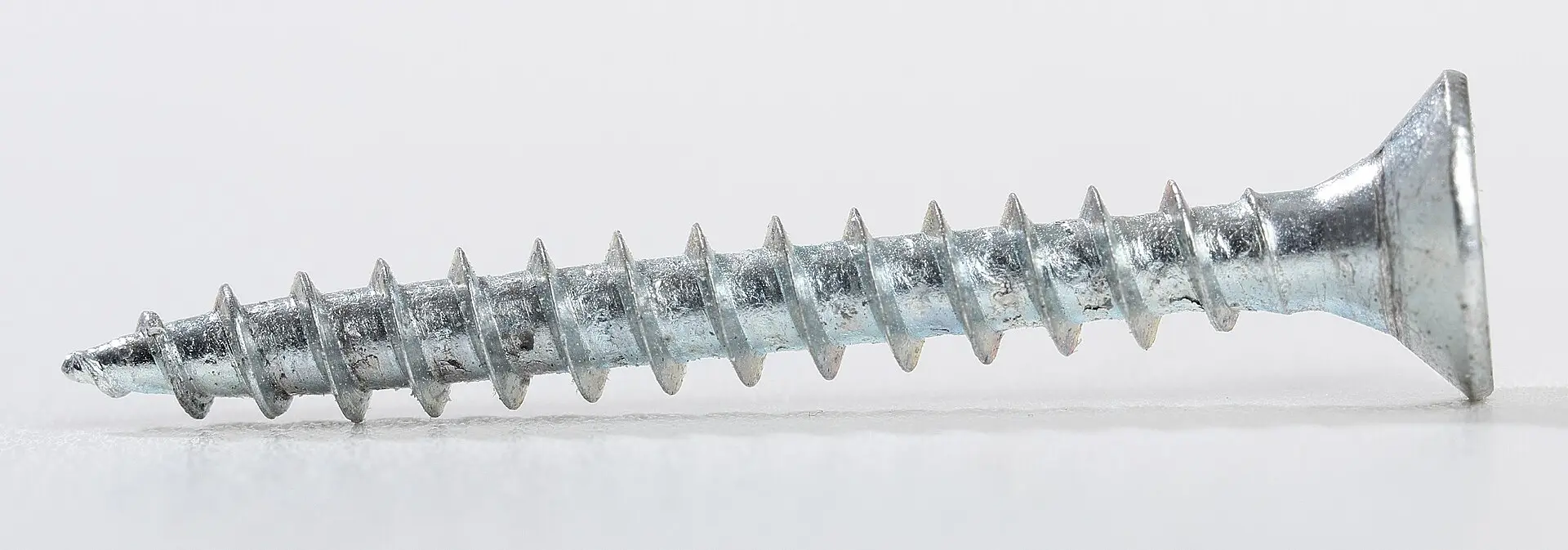

Key points
- Corrosion of metal in wood needs moisture: researchers observe a threshold of about 15 to 20% wood moisture content, and raised-bed walls are wetter than that much of the year.
- For preservative-treated wood, the US residential code (IRC R317.3.1) requires hot-dip galvanized, stainless, silicon bronze or copper fasteners; connectors at least G185 if the maker gives no rule.
- Simpson Strong-Tie rates ACQ-Type D more corrosive than copper azole, micronized copper azole or CCA-C.
- Tannins and acids matter: steel corroded at 279 µm per year in oak extract against 74 µm per year in black locust extract in a USDA lab test.
- Do not mix metals: 304 screws should not be used with 316 connectors, and galvanized screws corrode faster with stainless brackets.
Why raised-bed screws corrode faster than deck screws
Fasteners in a raised bed corrode faster than in most outdoor woodwork because the wood around them stays wet, and corrosion of metal in wood is driven by moisture. A USDA Forest Products Laboratory report by Samuel Zelinka (FPL-GTR-220, 2013) summarises the research: corrosion of fasteners embedded in wood is an aqueous process, and researchers have observed a threshold moisture content between 15% and 20% below which it does not occur.
A deck board dries between rains. The wall of a raised bed has moist soil pressed against one face all season, so the wood around a screw can stay above that threshold for months. Three further factors decide how fast the metal goes: what the wood was treated with, which natural chemicals the species contains, and whether different metals touch each other. Each is covered below, followed by a selection table.
Copper-treated lumber: what the code requires
Modern pressure-treated lumber contains copper, and copper drives corrosion of steel and zinc. In Zelinka’s analysis, wood treated with a copper-free preservative (DDAC) was only slightly more corrosive than untreated wood, which points to the copper as the cause. Simpson Strong-Tie, a major US maker of wood connectors, states that “ACQ-Type D is more corrosive than Copper Azole, Micronized Copper Azole, or CCA-C”, and that borate (SBX-DOT) treatment is less corrosive than CCA-C.
The International Residential Code, section R317.3.1 (2018 edition), sets the minimum for fasteners in preservative-treated wood:
- Fasteners, including nuts and washers, must be hot-dipped zinc-coated galvanized steel, stainless steel, silicon bronze or copper.
- Staples must be stainless steel.
- Connectors (brackets, hangers) follow the manufacturer’s recommendations, or at least ASTM A653 type G185 zinc-coated steel if there are none.
- Exceptions include steel bolts 1/2 in (12.7 mm) or larger, and mechanically deposited zinc to ASTM B695 Class 55 for fasteners other than nails, staples and timber rivets.
G185 means 1.85 oz of zinc per square foot of sheet, both sides combined, roughly twice the common G90 coating (0.90 oz/ft², about 0.76 mil or roughly 19 µm per side, according to the American Galvanizers Association). Electroplated “zinc-plated” screws are not on the list. For the background on ACQ, CA and MCA in vegetable beds, see pressure-treated wood in the vegetable garden.
What the Forest Service tests found on galvanized vs steel
Galvanizing is permitted by code, but laboratory data show zinc is not immune in treated wood. In a one-year exposure test at 27 °C (81 °F) and 100% relative humidity, Zelinka and colleagues drove plain steel and hot-dip galvanized fasteners into Southern Pine treated with several preservatives:
| Result | Detail |
|---|---|
| Corrosion rates | about 1 to 35 µm per year across treatments, “small in absolute terms” |
| Galvanized vs plain steel | galvanized corroded faster than steel in every treatment |
| Visible red rust on galvanized | observed in ACQ and copper azole |
| Industry accelerated test (Simpson, over 6,000 replicates) | ACQ and copper azole about twice as corrosive as CCA |
| Caveat | accelerated tests correlate poorly with service conditions |
Zinc works by corroding first and protecting the steel beneath. Once the coating is consumed, the steel core corrodes. Simpson states that it cannot estimate the service life of its products in treated wood, and asks buyers to get the AWPA use category and preservative retention from the lumber supplier, because both change corrosivity.
Tannins and acidity: cedar, oak and other durable woods
Untreated durable woods are not neutral either: many are acidic and rich in extractives, and these attack steel when wet. In Zelinka’s report, a study of wood extracts found that at a given pH more tannin inhibited corrosion, but lower pH increased it. Measured corrosion rates of steel in four extracts:
| Wood extract | pH | Steel corrosion rate (µm/year) |
|---|---|---|
| Oak | 4.3 | 279 |
| Pine | 4.5 | 334 |
| Elm | 6.5 | 159 |
| Black locust | 5.1 | 74 |
These are rates in liquid extract, much higher than in solid wood, and useful for comparing species rather than predicting life. The report also cites oak as very acidic and among the most corrosive solid woods, and quotes a pH range of 2.9 to 4.7 for western red cedar.
The second problem is staining. The USDA Wood Handbook (chapter 7) explains that extractives react with iron in the presence of moisture and cause dark stains, and that stainless steel, aluminum or hot-dipped galvanized nails alleviate it. The Western Red Cedar Lumber Association says electroplated fasteners react with cedar’s natural oils and cause stains and streaks, recommends stainless steel, and accepts double hot-dipped galvanized as an economical alternative. For the durability side of oak, chestnut and robinia, see black locust and larch for raised beds.
304 vs 316 stainless (A2 vs A4)
Type 304 stainless is enough for most raised beds, and 316 is for salt exposure. Simpson Strong-Tie describes its 304/305 fasteners as having “very good corrosion resistance” and recommends them for exterior wood-to-wood connections in wet environments and preservative-treated wood, explicitly including garden projects, fencing and ground contact. It reserves 316 (“maximum corrosion resistance”) for ocean and waterfront exposure, chlorides and de-icing salts. The Western Red Cedar Lumber Association gives the same split: 304 (18-8) for most uses, 316 for salt air.
In Europe, stainless fasteners are marked A2 or A4 rather than 304 or 316. According to New Steel Construction’s advisory note AD 342, A2 has corrosion resistance equivalent to grade 1.4301 (304), and A4, which contains molybdenum, is equivalent to grade 1.4401 (316). Copper and silicon bronze are also permitted by the IRC for treated wood, and the Wood Handbook reports that copper, silicon bronze and 300-series stainless nails performed well in CCA- and ACA-treated wood.
Mixed metals and coated screws
Two common mistakes cut fastener life even when each part is “outdoor rated”. The first is mixing metals. The Wood Handbook says a connector and its fasteners should be the same metal to avoid galvanic corrosion. Simpson specifies that 304/305 fasteners are not recommended with 316 connectors and that galvanized fasteners corrode faster when used with stainless connectors. If you use galvanized corner brackets, use galvanized screws of a matching coating; if the brackets are stainless, use stainless screws. Corner hardware options are compared in raised bed corner joints.
The second is relying on a coating on hardened steel. Many exterior “deck screws” are hardened carbon steel with a polymer or ceramic coating. The Wood Handbook notes that polymer coatings protect by isolating the metal, and that damage during insertion leads to pitting. Simpson advises using hardened fasteners only in dry service. A raised bed is wet service.
Which fastener for which bed
The table combines the code requirements, the manufacturer guidance and the lab results above into a selection guide. “Acceptable” means meeting the cited requirement or recommendation; it is not a service-life guarantee.
| Bed material and site | Preferred | Acceptable | Avoid |
|---|---|---|---|
| Untreated cedar, redwood, larch, pine | 304 / A2 stainless | Hot-dip galvanized (staining possible on cedar) | Electroplated zinc, bright steel |
| Oak, chestnut (high tannin, acidic) | 304 / A2 stainless | Silicon bronze | Bright steel, electroplated zinc |
| Copper-treated lumber (ACQ, CA, MCA) | 304 / A2 stainless | Hot-dip galvanized; G185 connectors | Electroplated zinc, bright steel |
| Any wood near the coast or salted roads | 316 / A4 stainless | 304 with more frequent inspection | Electroplated zinc, bright steel |
| Any bed with stainless brackets | Same grade stainless | None | Galvanized screws |
Size and placement matter as much as the metal: pre-drill near board ends in species that split, such as larch, and drive screws so they do not sit in the soil-contact face where they stay wettest. For a full build sequence with quantities, see how to build a 4x8 raised bed. If you also fit wire mesh under the bed, the same metal-choice logic applies to hardware cloth against gophers and voles.
Method and limits
This page is based on the USDA Forest Products Laboratory corrosion report FPL-GTR-220 and Wood Handbook chapter 7, the 2018 IRC section R317.3 as summarised by the International Code Council, Simpson Strong-Tie technical pages, the American Galvanizers Association, the Western Red Cedar Lumber Association and a steel-construction advisory note on A2/A4 grades. Laboratory corrosion rates come from high-humidity or extract tests and are for comparison, not service-life prediction. No source gives a lifespan in years for any screw type in a raised bed, and we did not find a peer-reviewed test of fasteners in garden-bed conditions.
Frequently asked questions
Do I need stainless steel screws for a cedar raised bed?
They are the best choice. The Western Red Cedar Lumber Association recommends stainless steel, says 304 grade gives adequate corrosion resistance for most uses and 316 for salt air, and warns that electroplated fasteners react with cedar's natural oils and cause stains and streaks. Double hot-dipped galvanized screws are an acceptable second choice.
Can I use deck screws in a raised bed?
Only if they are rated for the job. Many deck screws are hardened carbon steel with a polymer or ceramic coating. Simpson Strong-Tie advises using hardened fasteners only in dry service, and the USDA Wood Handbook notes that polymer coatings damaged during driving can lead to pitting. Wet soil contact is not dry service, so stainless is safer.
What is the difference between 304 and 316 stainless screws?
Type 316 contains molybdenum and resists chlorides better. Simpson Strong-Tie recommends 304/305 for exterior wood in wet conditions and preservative-treated wood, and 316 for ocean, waterfront, chloride and de-icing salt exposure. In European marking, A2 corresponds to 304 and A4 to 316.
Are galvanized screws OK with pressure-treated wood?
Hot-dip galvanized fasteners are permitted by the International Residential Code for preservative-treated wood, but electroplated zinc is not. In a one-year USDA Forest Products Laboratory test at 100% humidity, galvanized fasteners corroded faster than plain steel in every treatment, so stainless is the longer-lasting option in a permanently damp bed.
Why do screws leave black stains on cedar or oak?
Extractives in the wood react with iron when moisture is present, producing dark stains. The USDA Wood Handbook says stainless steel, aluminum or hot-dipped galvanized fasteners alleviate the problem; the Western Red Cedar Lumber Association says electroplated fasteners cause stains and streaks on cedar.
Sources
- USDA Forest Service, Forest Products Laboratory (S. Zelinka) (2013). Corrosion of fasteners in wood treated with newer wood preservatives (FPL-GTR-220)
- USDA Forest Service, Forest Products Laboratory (2021). Wood Handbook: Wood as an Engineering Material (FPL-GTR-282), chapter 7, Fastenings
- International Code Council (2018). 2018 IRC Significant Changes: R317.3 Fasteners and connectors in contact with preservative-treated and fire-retardant-treated wood
- Simpson Strong-Tie (2026). Corrosion information: preservative-treated wood and fastener selection
- Simpson Strong-Tie (2026). Stainless-steel fasteners
- American Galvanizers Association (2026). ASTM A123 and G90 specifications
- Western Red Cedar Lumber Association (Real Cedar) (2026). Fasteners for cedar decking
- New Steel Construction (Steel Construction Institute / BCSA) (2010). AD 342: Stainless steel fasteners